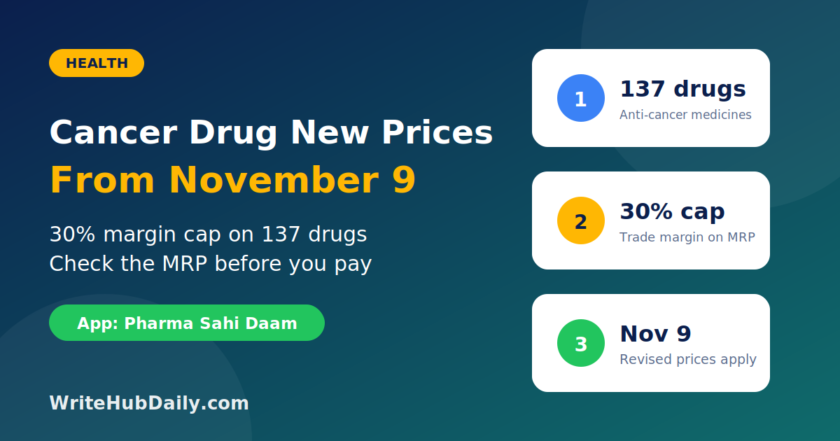

The cancer drug price cap India announced this month is now official. The National Pharmaceutical Pricing Authority (NPPA) has capped trade margins on 137 non-scheduled anti-cancer drugs at 30% of the maximum retail price (MRP). The revised prices are due to apply from November 9, 2026.
Cancer treatment can be a heavy financial burden for families, and many newer medicines are expensive. Here is a clear explanation of what the cap means, which medicines are covered, and how patients and caregivers can check the new prices.
Cancer Drug Price Cap India: Key Facts
| Item | Details |
|---|---|
| Who issued it | NPPA, under the Department of Pharmaceuticals |
| What is capped | Trade margin, at 30% of MRP |
| Medicines covered | 137 non-scheduled anti-cancer drugs |
| Expected price impact | MRPs of some medicines could fall by up to 70% |
| Revised prices apply from | November 9, 2026 |
| Where to check prices | Pharma Sahi Daam app and the NPPA website |
What Is a Trade Margin?
The trade margin is the gap between the price at which a manufacturer sells a medicine to distributors and the final MRP the patient pays. It covers the earnings of wholesalers, retailers and others in the supply chain.
The new cap limits this margin to 30% of MRP for the listed anti-cancer drugs. According to official sources quoted in news reports, the cap applies only to the trade margin, so manufacturers' own selling prices and revenue are not directly affected.
Why Did the Government Step In?
NPPA's analysis of market data found that the average trade mark-up on non-scheduled anti-cancer drugs was around 170%, with mark-ups reaching up to 700% in some cases. Officials expect the measure to bring down MRPs by up to 70% and to save patients about ₹2,500 crore a year in out-of-pocket spending.
This is not the first such step. In 2019, NPPA capped trade margins on 42 selected non-scheduled anti-cancer drugs on a pilot basis. Reports said this led to price reductions of up to 91% on MRPs and annual savings of about ₹984 crore across 526 brands.
Which Medicines Are Covered?
The list covers 137 non-scheduled anti-cancer drugs. According to the official statement reported by IANS, these include:
- Immunotherapy drugs used to treat more than 20 types of cancer.
- Denosumab, used by some breast and prostate cancer patients.
- Pegfilgrastim, used to help prevent neutropenia in cancer patients.
- Bevacizumab, an approved drug for colon, ovarian and cervical cancer.
The statement says that widely used medicines such as Pembrolizumab, Durvalumab and Osimertinib are expected to become more affordable. Early reports on October 8 spoke of 110 drugs, including 35 patented medicines. The final NPPA notification, as reported later, lists 137 drugs.
Timeline: What Happens When
- October 8, 2026: the Centre decided to cap trade margins at 30% of MRP for non-scheduled anti-cancer drugs.
- Around October 18, 2026: the NPPA notification for 137 drugs was reported.
- Within 7 days of the Gazette notification: manufacturers must tell NPPA their revised prices.
- November 9, 2026: revised prices become effective, and retailers and hospitals must charge the reduced prices.
What Patients and Families Can Do
- Check prices: use the Pharma Sahi Daam app or the NPPA website to look up the revised price of a medicine.
- Ask your hospital or pharmacy: hospitals must display revised prices prominently on their websites, and pharmacies must display the new prices.
- Compare after November 9: check that the bill matches the revised MRP, and keep your bills and prescriptions.
- Raise concerns: if you are charged more than the revised price, you can complain through the NPPA website or contact your local drug control office.
- Talk to your doctor: do not stop, delay or change any cancer treatment because of price news. Ask your oncology team if you have questions about costs or alternatives.
What to Watch Next
- Implementation: how quickly manufacturers, retailers and hospitals update their prices and stock before November 9.
- Real savings: whether patients actually see lower bills, including for hospital-supplied medicines.
- Wider coverage: whether similar margin limits are extended to other costly medicines.
- Industry response: how manufacturers and the trade react once the new prices are in force.
Healthcare costs are a growing concern as India's population ages. Read our explainer on India's ageing population and what it means for healthcare, and our guide to the Tele-MANAS mental health helpline for emotional support during a health crisis.
Frequently Asked Questions
What is the cancer drug price cap in India?
It is a limit on the trade margin, set at 30% of MRP, for 137 non-scheduled anti-cancer drugs, announced by NPPA to reduce the cost of cancer treatment for patients.
When will the new cancer drug prices apply?
Revised prices are due to be effective from November 9, 2026.
How can I check the new price of a cancer medicine?
Use the Pharma Sahi Daam app or the NPPA website to check revised prices, and ask your hospital or pharmacy to show you the updated price list.
Will every cancer medicine become cheaper?
No. The cap covers the 137 non-scheduled anti-cancer drugs on the NPPA list. The amount of reduction will differ from drug to drug, depending on how large the existing trade margin was.
Should I change my treatment because of the new prices?
No. Always follow your doctor's advice. Price changes do not change your prescription.
Conclusion
The cancer drug price cap India has introduced targets one of the biggest drivers of high retail prices: large trade mark-ups. If the revised prices are applied as planned from November 9, many patients and families could see lower bills for expensive cancer medicines. Check the revised prices, keep your bills, and speak to your doctor about any treatment decisions.
Disclaimer: This article is for general information and is not medical or financial advice. Details are based on government statements and media reports published in October 2026 and may change. For official information, visit the NPPA website, and consult your doctor about your treatment.