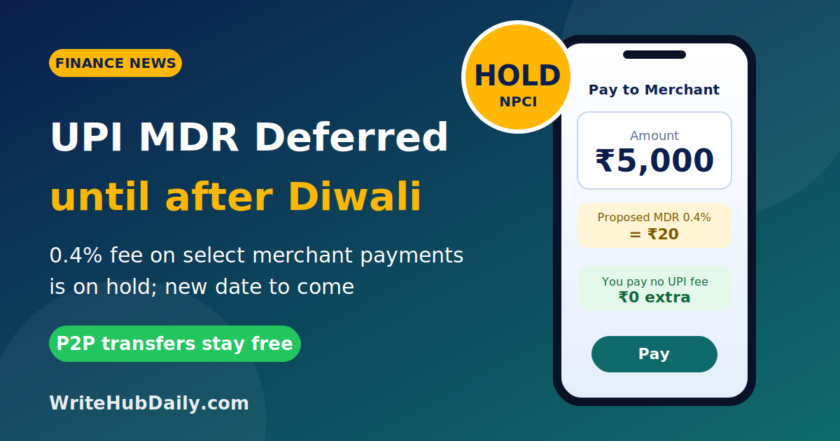
UPI MDR after Diwali is the question many shopkeepers and users are asking now that the festival is over. On October 13, 2026, NPCI said the Merchant Discount Rate (MDR) on select person-to-merchant (P2M) UPI payments would be implemented immediately after Diwali, on a date to be notified separately. Reports at that time said the fee structure itself had not changed.
This guide explains what to check, what stays free, and how to be ready for the start date. For the full background, read our main explainer on the UPI new rules 2026 and the 0.4% MDR.
UPI MDR After Diwali: Status Check
| Item | What was announced |
|---|---|
| Start date | After Diwali, on a date to be notified by NPCI. Check for the latest announcement |
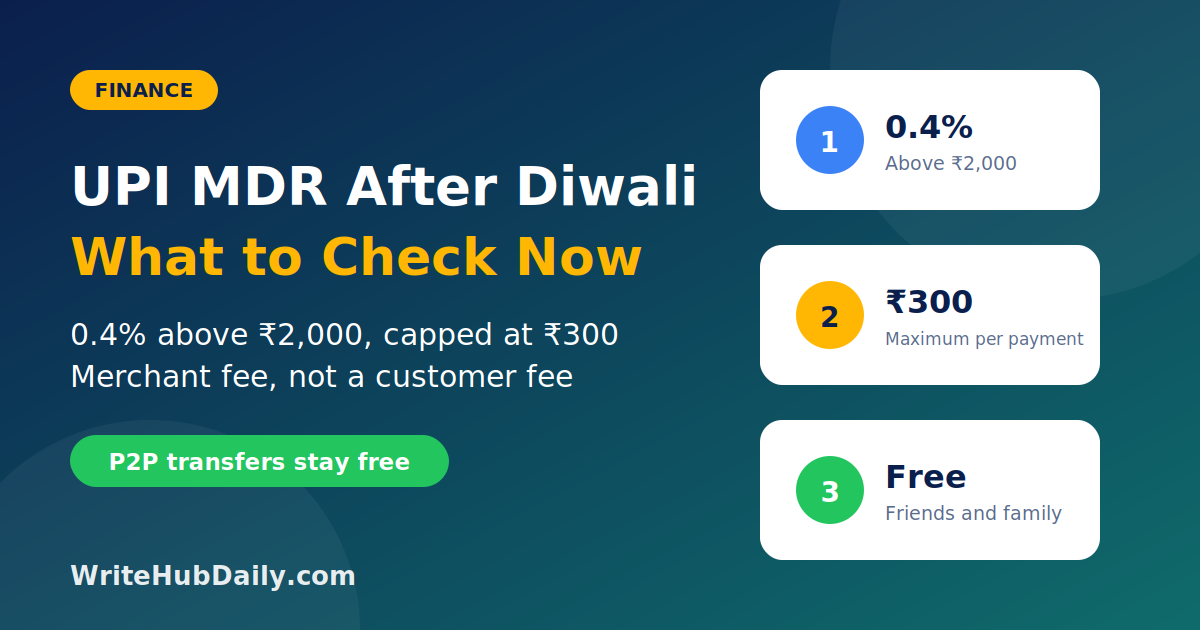
| Standard MDR | 0.4% on specified P2M payments above ₹2,000, with a cap of ₹300 per payment |
| Person-to-person payments | Free |
| Payments up to ₹2,000 | No MDR |
| Small merchants | Zero MDR on up to ₹1 lakh a month in UPI QR receipts, under the P2PM category |
| Customers | Not meant to pay the fee. Merchants are not supposed to pass it on |
What UPI Users Should Check
- Your payments to friends and family: these stay free and are not affected.
- Shop bills: if a shop asks for an extra charge for paying by UPI, you can raise it with the merchant, your UPI app or your bank.
- Scam messages: be careful about messages saying you must "pay an MDR fee" or "activate UPI". These are scams. See our guide to the fake delivery message scam and festive sale scams.
- Your app: keep it updated and read any notice from your bank or app carefully.
What Merchants Should Check
- Your category: ask your bank or payment provider whether your business falls under the standard 0.4% rate, the ₹5 flat rate for some sectors, the 0.02% capital markets rate, or zero MDR for small merchants.
- Your monthly QR receipts: check whether you stay within the ₹1 lakh small-merchant limit.
- Your payment mix: split your UPI payments into up to ₹2,000, above ₹2,000 and ₹75,000 or more, because the ₹300 cap starts at ₹75,000.
- Your statements: ask how MDR and any applicable taxes will appear on your settlement report.
- Your prices: do not add a UPI surcharge for customers.
Example Amounts
| Merchant payment | MDR on the merchant side |
|---|---|
| ₹2,000 or less | Nil |
| ₹5,000 | ₹20 |
| ₹25,000 | ₹100 |
| ₹75,000 | ₹300 (cap reached) |
| ₹2,00,000 | ₹300 |
The Supreme Court Case
On September 28, 2026, the Supreme Court declined to stay the framework and asked the Centre, the RBI and others to reply within four weeks. The petition is still pending, so check for fresh news on the hearing.
Where to Get Reliable Updates
- The official NPCI website and circulars.
- Notices from your bank and your UPI app.
- Government statements on PIB.
Frequently Asked Questions
Has the UPI MDR started?
NPCI said it would start after Diwali on a date to be notified. Check the latest announcement from NPCI for the confirmed date.
Will UPI payments to friends and family be charged?
No. Person-to-person transfers remain free.
Is a ₹2,000 payment charged MDR?
No. MDR applies to specified merchant payments above ₹2,000.
What is the maximum MDR?
The standard and capital-market rates are capped at ₹300 per payment.
Conclusion
UPI MDR after Diwali is a merchant-side change, and everyday users should not be charged. Keep using UPI as usual, check for the official start date, and stay alert to scam messages that use the fee as bait.
Disclaimer: This article is for general information and is not financial or legal advice. Rules, dates and exemptions can change. Check the latest notices from NPCI, the government, your bank and your payment provider.