A good board exam study plan is the best use of the next three months. If the CBSE board exams begin in mid-February, as in recent years, Class 10 and Class 12 students have roughly 100 days left. That is enough time to finish the syllabus, revise twice and practise full papers, if you plan it well.
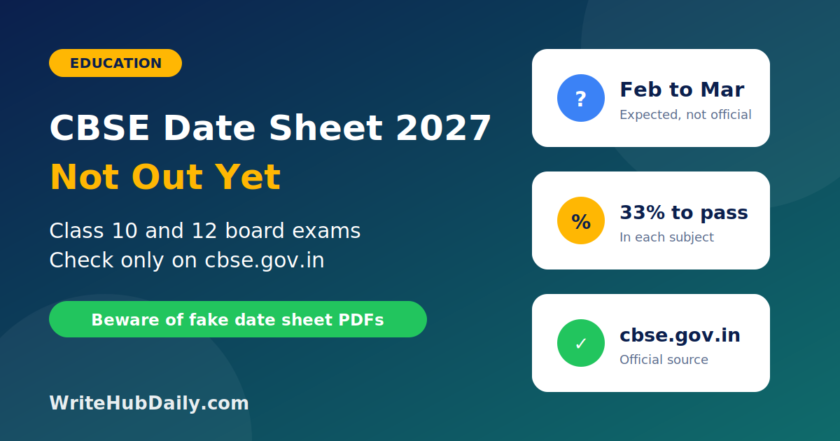
The official date sheet for 2027 had not been released at the time of writing, so treat February as an estimate and check cbse.gov.in for confirmed dates. This plan works for CBSE and for most other boards, because it is built around phases, not fixed dates.
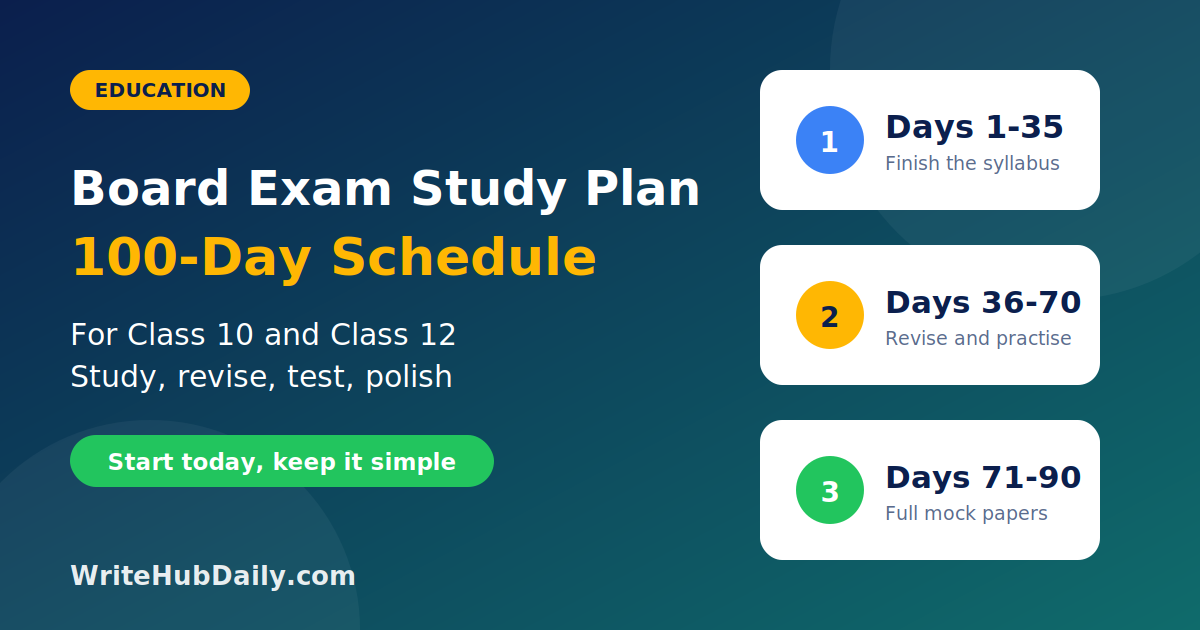
Board Exam Study Plan: The 100-Day Overview
| Phase | Days | Goal |
|---|---|---|
| 1. Complete and understand | Days 1 to 35 | Finish the syllabus, clear doubts and make short notes |
| 2. Revise and practise | Days 36 to 70 | First revision, topic-wise questions, previous years' papers |
| 3. Test and fix | Days 71 to 90 | Full-length mock papers, timing and weak areas |
| 4. Final polish | Last 10 days | Light revision, formulas, diagrams and rest |
Step 1: Set Up Your Plan (Day 1)
- List every subject and chapter. Use your latest syllabus from the official board website and your school.
- Mark each chapter: strong, medium or weak.
- Check weightage. Look at the marking scheme and sample papers to see which chapters carry more marks.
- Pick a daily time. Most students can manage 4 to 6 focused hours on school days and a few more on weekends, but choose what you can keep up.
- Write a weekly timetable and put it where you study.
Step 2: A Simple Daily Routine
- Morning (1.5 to 2 hours): the hardest subject or the weakest chapter, when you are fresh.
- After school: 1 to 2 hours of a second subject, with practice questions.
- Evening: 1 hour of revision or reading notes.
- Night (20 to 30 minutes): quickly recall what you studied that day without looking at your notes.
- Breaks: take 5 to 10 minutes after every 45 to 50 minutes of study. Walk, stretch or drink water, and keep your phone away.
Step 3: Use a Weekly Cycle
- Monday to Friday: study new chapters and practise questions.
- Saturday: revise the week's work and solve a timed practice paper for one subject.
- Sunday: a lighter day. Fix mistakes, plan the next week and rest.
Step 4: Use the Right Material
- Study from your NCERT books and class notes first.
- Practise with the board's sample papers and marking schemes, and previous years' papers.
- Keep a "mistake notebook" with the questions you got wrong and the correct method.
- If you use AI tools for explanations, always check the answers against your textbook. See our guide on how to use AI for studying.
Step 5: Mock Tests and Time Management
From about day 70, solve at least one full paper every few days in exam conditions: same time limit, no phone and no notes. Check your answers against the marking scheme and write down where you lost marks. Practise finishing with 10 to 15 minutes to review. For more help, read our guides on study tips for students and time management.
Look After Your Health and Mind
- Sleep 7 to 8 hours, because memory improves with sleep.
- Eat regular meals and drink enough water.
- Do some exercise or a walk most days.
- Talk to a parent, teacher or friend if you feel overwhelmed. The Tele-MANAS helpline, 14416, offers free support at any time.
Frequently Asked Questions
How many hours should I study for board exams?
It depends on you, but regular, focused study of about 4 to 6 hours on school days is realistic for many students. Quality and consistency matter more than long hours.
When will the CBSE date sheet 2027 come out?
CBSE had not announced it at the time of writing. Check cbse.gov.in and your school's notices.
Is it too late to start now?
No. With about 100 days left, a clear plan and regular work can make a big difference. Start with your weakest subjects.
Conclusion
A strong board exam study plan has four parts: finish the syllabus, revise twice, practise full papers, and polish in the last days. Start today, keep the plan simple, and look after your sleep and health.
Disclaimer: This article is for general guidance. Exam dates and syllabus can change, so confirm them with your board and school.