AI Agents in 2026: What They Are, How They Work, and Why They Matter
Artificial intelligence is moving beyond simple chatbots. In 2026, a growing number of AI systems can do more than answer questions. They can understand a goal, plan multiple steps, use connected tools, and complete tasks with limited human intervention.
These systems are commonly called AI agents or agentic AI.
AI agents are becoming increasingly important in workplaces, software development, customer service, research, cybersecurity, and everyday productivity. Instead of asking AI for one answer at a time, users can increasingly delegate larger tasks and review the results.
But greater autonomy also creates new questions about privacy, security, accuracy, permissions, and human oversight.
In this guide, we explain what AI agents are, how they work, what they can do in 2026, their benefits and risks, and how businesses and everyday users can use them responsibly.
Table of Contents
- What Is an AI Agent?
- How Do AI Agents Work?
- AI Agents vs. Traditional Chatbots
- What Can AI Agents Do in 2026?
- Benefits of AI Agents
- Risks and Security Concerns
- How Businesses Can Use AI Agents
- How Students and Everyday Users Can Use AI Agents
- How to Use AI Agents Safely
- The Future of AI Agents
- Frequently Asked Questions
- Final Thoughts
What Is an AI Agent?
An AI agent is a software system that can work toward a goal by reasoning through tasks, using tools, and taking actions.
A traditional chatbot usually follows a simple pattern:
User asks a question → AI generates an answer.
An AI agent can follow a more advanced process:
User provides a goal → AI plans tasks → AI uses tools → AI performs actions → AI reviews results → AI continues or asks for help.
For example, instead of asking an AI assistant to explain a spreadsheet, a user might give an agent a larger task such as analyzing the spreadsheet, identifying unusual results, creating a summary, and preparing a report.
The exact capabilities depend on the specific AI system, tools, permissions, and safeguards.
How Do AI Agents Work?
1. Understanding the Goal
The agent first interprets what the user wants to accomplish.
For example:
Analyze this month’s sales data and identify the biggest changes.
The agent needs to understand the desired outcome rather than simply respond with a sentence.
2. Planning
The system can break a larger goal into smaller steps.
- Read the sales file.
- Organize the data.
- Compare the current month with previous results.
- Identify significant changes.
- Prepare a summary.
3. Using Tools
Agents can sometimes connect to tools such as:
- Web search
- Databases
- Spreadsheets
- Code execution
- Business applications
- Documents
- APIs
- Cloud services
This allows an agent to do more than generate text.
4. Taking Actions
Depending on its permissions, an agent may be able to create files, update information, run code, send messages, or perform other tasks.
This is one of the biggest differences between an ordinary chatbot and an agent.
5. Reviewing Results
More advanced agentic systems can evaluate intermediate results and determine whether another step is required.
This allows them to work through longer tasks rather than stopping after one response.
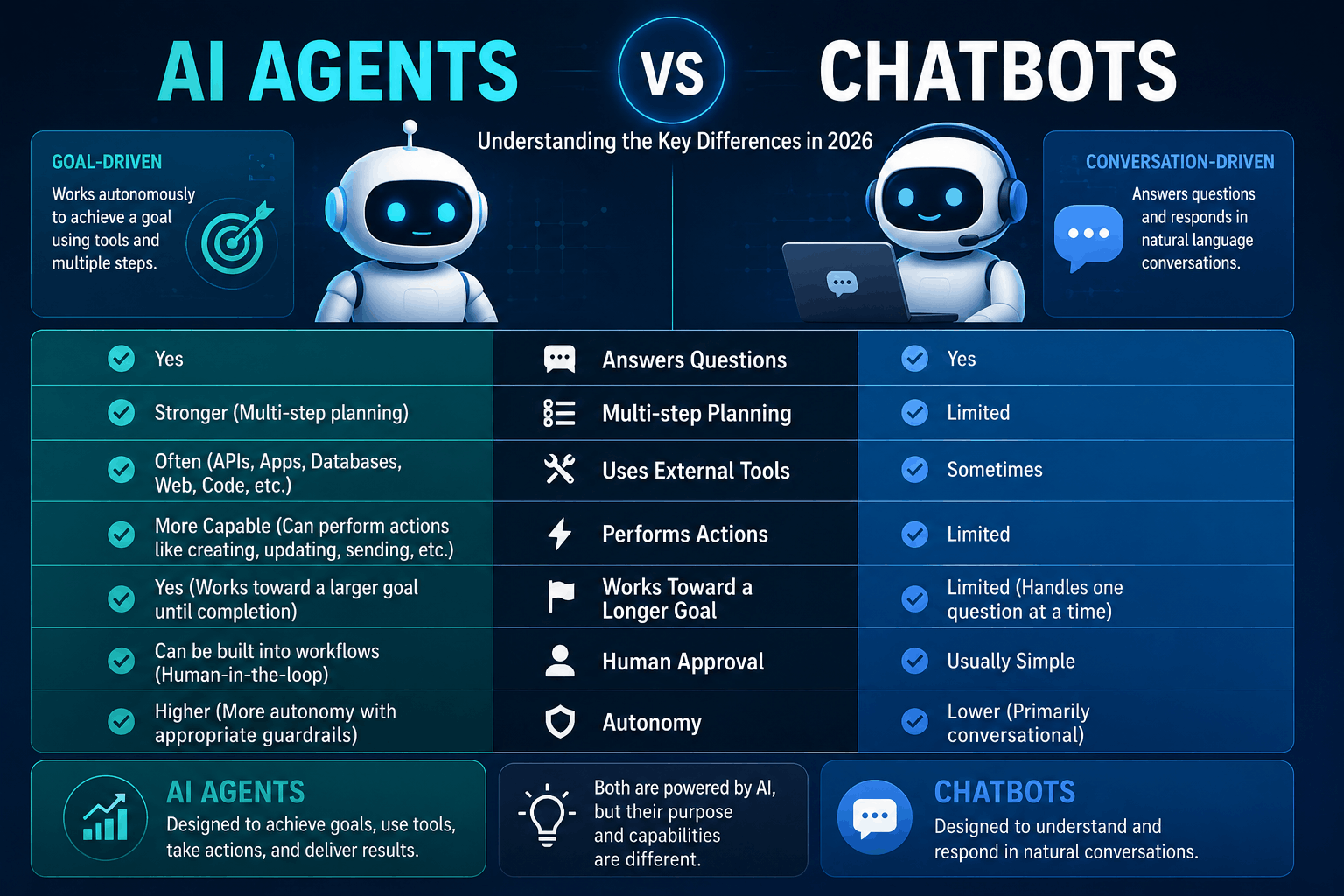
AI Agents vs. Traditional Chatbots
The terms are sometimes used interchangeably, but there is an important difference.
Traditional Chatbots
- Answers questions: Yes
- Multi-step planning: Limited
- Uses external tools: Sometimes
- Performs actions: Limited
- Works toward a longer goal: Limited
- Human approval: Usually simple
- Autonomy: Lower
AI Agents
- Answers questions: Yes
- Multi-step planning: Stronger
- Uses external tools: Often
- Performs actions: More capable
- Works toward a longer goal: Yes
- Human approval: Can be built into workflows
- Autonomy: Higher
A chatbot is primarily focused on conversation.
An AI agent is designed to accomplish a goal.
However, the boundary is not always clear. Some modern AI assistants combine conversational interfaces with agent-like capabilities.
What Can AI Agents Do in 2026?
Software Development
Coding agents can help developers with tasks such as:
- Writing code
- Debugging
- Testing
- Refactoring
- Analyzing repositories
- Automating development tasks
- Working through larger coding assignments
Business Research
An agent can potentially gather information from multiple sources, organize findings, compare data, and prepare a report.
Instead of asking several separate questions, a user can provide a larger research objective.
Customer Support
AI agents can help handle customer requests by understanding the problem, searching relevant information, and guiding customers through solutions.
More advanced systems can also connect with business tools to complete parts of a support workflow.
Data Analysis
Agents can assist with:
- Cleaning data
- Finding patterns
- Creating summaries
- Generating calculations
- Producing reports
- Explaining unusual results
Human review remains important when the results influence significant decisions.
Cybersecurity
AI agents are increasingly being explored for security operations.
They can assist with activities such as investigating alerts, organizing security information, and helping analysts prioritize potential threats.
However, cybersecurity agents require particularly strong controls because excessive permissions or incorrect actions can create serious problems.
Personal Productivity
For everyday users, agentic AI may help with:
- Organizing information
- Research
- Writing
- Scheduling
- Document management
- Task planning
- Repetitive computer work
Benefits of AI Agents
1. Saves Time
AI agents can automate repetitive multi-step tasks that would otherwise require significant manual work.
2. Handles Complex Workflows
Instead of completing one small action, an agent can potentially coordinate several related tasks.
3. Improves Productivity
Workers can delegate routine activities and spend more time reviewing results, making decisions, and solving higher-value problems.
4. Works Across Different Tools
An agent connected to appropriate applications can move information between systems and help coordinate workflows.
5. Supports Non-Technical Users
Agentic AI is not limited to programmers. As these systems become easier to use, people in areas such as marketing, finance, administration, research, and customer support can use them for practical tasks.
Risks and Security Concerns
Excessive Permissions
An agent should not automatically receive access to everything a user can access.
For example, an agent that only needs one document should not necessarily have access to an entire cloud storage account.
Incorrect Actions
AI can make mistakes. If an agent is allowed to take action automatically, an incorrect decision can have a larger impact than an incorrect chatbot answer.
Privacy Risks
Agents may process emails, documents, customer information, business data, or other sensitive material.
Users should understand what information an agent can access and how that information is handled.
Prompt Injection
Agents that interact with external content can encounter instructions embedded in webpages, documents, or other data.
These instructions may attempt to manipulate the agent into taking an unintended action.
Account and Identity Risks
As organizations deploy more AI agents, managing agent identities, credentials, and permissions becomes increasingly important.
How Businesses Can Use AI Agents
Businesses should start with clearly defined use cases rather than giving agents unlimited access.
1. Start With Repetitive Tasks
- Document processing
- Internal research
- Report preparation
- Customer support assistance
- Data organization
- Software testing
2. Limit Permissions
Follow the principle of least privilege. Give an agent only the access required for its specific task.
3. Require Approval for High-Risk Actions
Actions involving money, sensitive data, legal decisions, account changes, or external communications may require human approval.
4. Monitor Agent Activity
Organizations should understand what their agents are doing and review unusual or unexpected behavior.
5. Train Employees
Employees need to understand both the benefits and limitations of agentic AI.
How Students and Everyday Users Can Use AI Agents
Students can use AI agents to organize research, summarize information, brainstorm projects, create study plans, and automate repetitive tasks.
However, students should still verify important information and follow academic integrity rules.
Everyday users can experiment with agents for productivity tasks such as organizing documents, preparing travel research, managing information, or creating personal workflows.
The safest approach is to start with low-risk tasks and increase permissions only when necessary.
How to Use AI Agents Safely
Before giving an AI agent access to your information or accounts, ask these questions:
What can the agent see?
Check whether it can access documents, email, contacts, cloud storage, or other private information.
What can the agent change?
An agent that can read information presents a different risk from an agent that can delete, purchase, send, or modify information.
Does it need all these permissions?
Remove unnecessary permissions whenever possible.
Can I review its actions?
For important workflows, human approval can provide an additional safety layer.
What happens if the agent makes a mistake?
Create clear limits and recovery procedures before allowing an agent to perform important actions.
For more guidance, see our related article:
How to Use AI Safely in 2026: 10 Important Privacy and Security Tips.
The Future of AI Agents
AI agents are likely to become a larger part of software and workplace workflows.
The direction is increasingly moving from individual prompts toward agentic workflows that can coordinate complex processes.
This does not mean every task will be fully automated.
Instead, the more realistic direction is a partnership between people and AI:
Humans define goals and provide judgment. AI handles appropriate tasks and execution. Humans review important outcomes.
This model can provide the benefits of automation while keeping people responsible for important decisions.
Frequently Asked Questions
What is an AI agent?
An AI agent is an AI-powered software system designed to work toward a goal by planning tasks, using tools, and potentially taking actions with limited human intervention.
What is the difference between AI and an AI agent?
Traditional AI tools may generate an answer or perform a specific function. An AI agent can be designed to pursue a larger goal by planning and completing multiple steps.
Are AI agents safe?
AI agents can be useful, but they introduce additional privacy, security, and reliability risks. Safe deployment requires appropriate permissions, monitoring, testing, and human oversight.
Can AI agents replace human workers?
AI agents can automate some tasks, but they do not eliminate the need for human judgment in every situation. Their impact will vary by job, industry, workflow, and the quality of the AI system.
Should I give an AI agent access to my email?
Only if the access is necessary for the task and you understand the permissions involved. Use the minimum access required and avoid granting unnecessary privileges.
Are AI agents useful for students?
Yes. They can help with research, organization, brainstorming, study planning, and repetitive tasks. Students should verify information and follow their school’s academic policies.
Final Thoughts
AI agents represent an important change in how people interact with artificial intelligence.
Instead of simply asking AI a question and receiving an answer, users can increasingly give AI a goal and allow it to complete multiple steps using connected tools.
This creates significant opportunities for productivity, business automation, software development, research, and everyday work.
But more autonomy requires more responsibility.
The safest approach is simple: start small, limit permissions, verify important results, monitor actions, and keep humans in control of high-impact decisions.
As AI agents become more common in 2026 and beyond, understanding how they work—and how to use them responsibly—will become an increasingly valuable digital skill.