
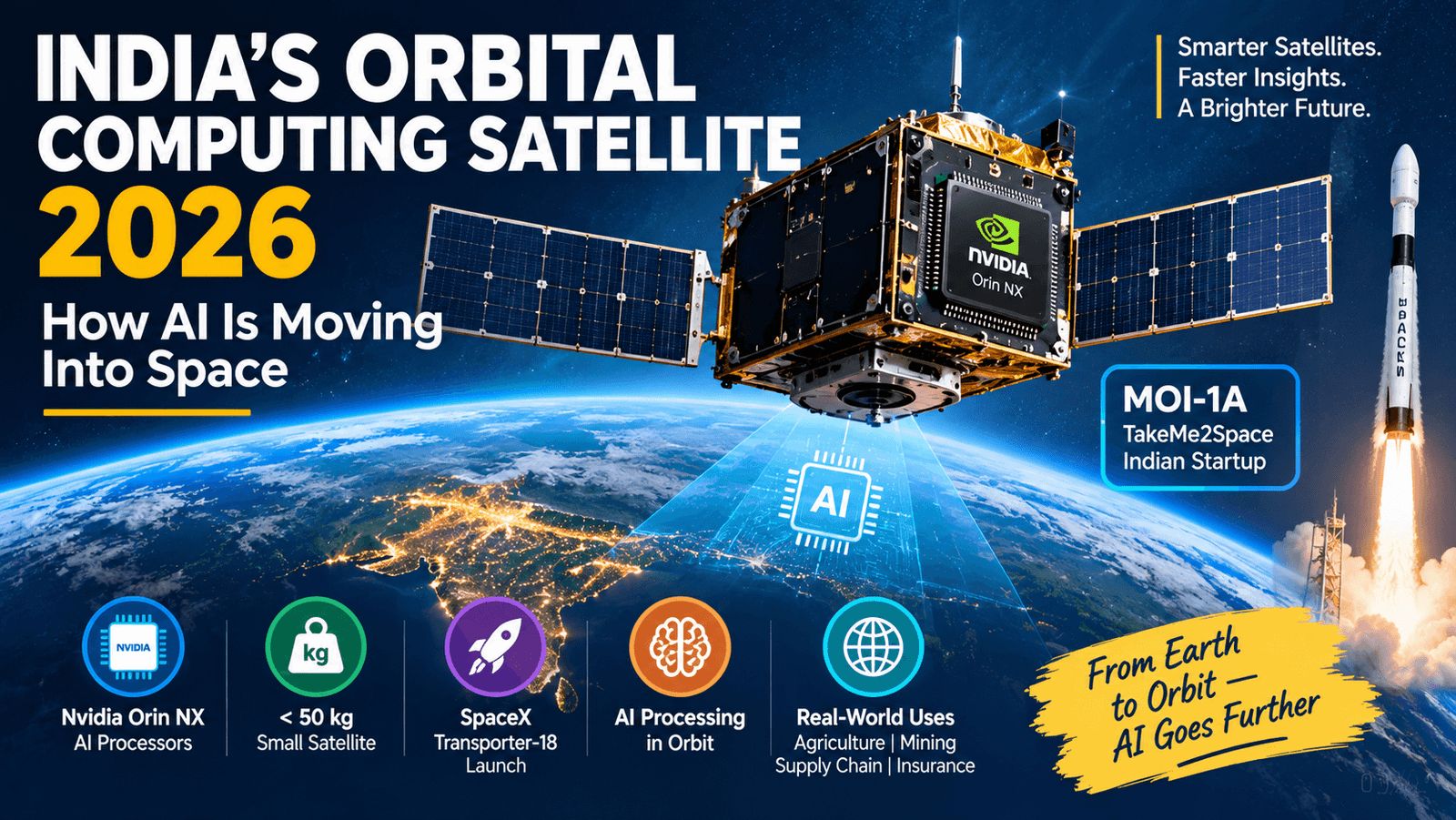
India orbital computing satellite 2026 technology is attracting attention as Indian space startup TakeMe2Space prepares to launch MOI-1A, a small satellite designed to perform computing and AI processing in orbit.
The concept is different from traditional satellites. Instead of collecting large amounts of data and sending the raw information back to Earth for processing, an orbital computing satellite can analyze some data while it is still in space.
What Is India's Orbital Computing Satellite?
TakeMe2Space's MOI-1A is a sub-50 kg spacecraft designed to perform computing tasks in orbit.
According to Reuters, the satellite is scheduled to fly on SpaceX's Transporter-18 rideshare mission and will carry Nvidia Orin NX edge-computing processors.
The goal is to demonstrate how AI models can operate directly on satellite hardware.
How Does Orbital Computing Work?
Traditional satellite data processing can involve sending large datasets from space to ground stations.
This can require significant communication bandwidth and may increase the time and cost required to process information.
With orbital computing, a satellite can perform some of the processing before sending information to Earth.
For example, instead of transmitting every image captured by a satellite, an AI model could identify specific objects or changes and send only the useful results.
Why Put AI in Space?
Satellite sensors can generate large amounts of information. Sending all of that data to Earth is not always the most efficient approach.
AI processing in orbit could help reduce the amount of raw data that needs to be transmitted.
Potential applications include:
- Agriculture monitoring
- Mining and resource monitoring
- Supply-chain analysis
- Insurance-related satellite data
- Geographic information systems
- Environmental monitoring
- Disaster monitoring
What Chip Does MOI-1A Use?
MOI-1A is reported to carry Nvidia Orin NX processors.
These processors are designed for edge computing and AI workloads, making them suitable for applications where data needs to be processed close to where it is generated.
In this case, the computing hardware is being placed directly on a satellite.
How Is This Different From a Normal Satellite?
A conventional observation satellite primarily collects data and transmits it to ground infrastructure.
An orbital computing satellite adds another layer: onboard processing.
| Traditional Satellite | Orbital Computing Satellite |
|---|---|
| Collects data | Collects data and processes some of it |
| More raw data may be transmitted | Processed results can reduce data transmission |
| Greater dependence on ground processing | More computing happens in orbit |
| Ground infrastructure handles much of the analysis | AI models can operate directly on the satellite |
Who Could Use Orbital AI?
TakeMe2Space has said it has customers across sectors including agriculture, mining, supply-chain management and insurance.
These industries can benefit from satellite information when decisions depend on large geographic areas or changing conditions.
For example, an agricultural company could use satellite imagery to identify changes in farmland, while a mining company could analyze specific geographic areas.
India's Growing Space Technology Ecosystem
The development of orbital computing is part of a broader expansion of India's private space sector.
Indian startups are increasingly working on satellite manufacturing, launch services, Earth observation, space data and other commercial applications.
Orbital computing adds another area: combining space hardware with artificial intelligence and edge computing.
Is This a Data Center in Space?
Not exactly.
MOI-1A is a small satellite designed for onboard computing rather than a large orbital data center.
However, the technology represents an early example of a broader idea: using satellites as computing platforms.
Other technology companies are also exploring space-based computing. Reuters recently reported that Google is testing its Project Suncatcher concept, including AI hardware in orbit.
What Are the Challenges?
Running computers in space is considerably more complicated than running them in a terrestrial data center.
- Radiation can affect electronic components.
- Power availability is limited.
- Cooling hardware must work without normal atmospheric airflow.
- Satellite launches are expensive.
- Hardware must survive launch vibrations and extreme conditions.
- Communication bandwidth remains an important constraint.
- Repairing hardware in orbit is difficult.
These challenges mean orbital computing is still an emerging technology rather than a replacement for conventional data centers.
What Could Come Next?
TakeMe2Space has discussed larger and networked satellites as part of its longer-term plans.
The company has said it plans larger satellites beginning in 2027, with the aim of increasing computing capacity and reducing costs.
If future missions demonstrate that AI processing in orbit can be performed reliably and economically, more companies could explore similar systems.
Why This Matters for AI
AI infrastructure is normally associated with data centers, GPUs, electricity and high-speed networks on Earth.
Orbital computing introduces another possibility: processing data closer to where satellite sensors collect it.
That could become useful as satellite constellations generate increasingly large amounts of imagery and sensor data.
India Orbital Computing Satellite 2026: Key Points
- TakeMe2Space is developing the MOI-1A satellite.
- The spacecraft weighs less than 50 kg.
- It is designed for computing and AI processing in orbit.
- It uses Nvidia Orin NX processors.
- The mission is planned for a SpaceX Transporter-18 rideshare launch.
- The goal is to process selected data before sending results to Earth.
- Potential users include agriculture, mining, supply-chain and insurance companies.
- Larger orbital computing satellites are part of the company's longer-term plans.
Frequently Asked Questions
What is orbital computing?
Orbital computing means performing computing or AI processing directly on a satellite instead of sending all collected data to Earth for processing.
What is MOI-1A?
MOI-1A is a small satellite being developed by Indian space startup TakeMe2Space for orbital computing applications.
Why use AI in space?
AI can analyze satellite data directly in orbit and potentially reduce the amount of raw information that needs to be transmitted to Earth.
Is orbital computing replacing data centers?
No. The technology is still experimental and has significant engineering, power, communication and cost challenges.
More Technology Guides from WriteHubDaily
- AI Infrastructure in 2026: Why Chips, Data Centers and Power Matter More Than Ever
- ASML Starts India Operations 2026: Jobs, Semiconductor Growth & Tata Dholera
- India Semiconductor Mission 2026: What Semicon 2.0 Means for Chip Manufacturing
- Googlebook 2026: Price, Features, Gemini AI & India Availability
Sources and Disclaimer
This article is based on reporting about TakeMe2Space's MOI-1A mission and the development of orbital computing. Launch schedules and technical plans can change, so readers should check the latest information from the company and launch provider.