
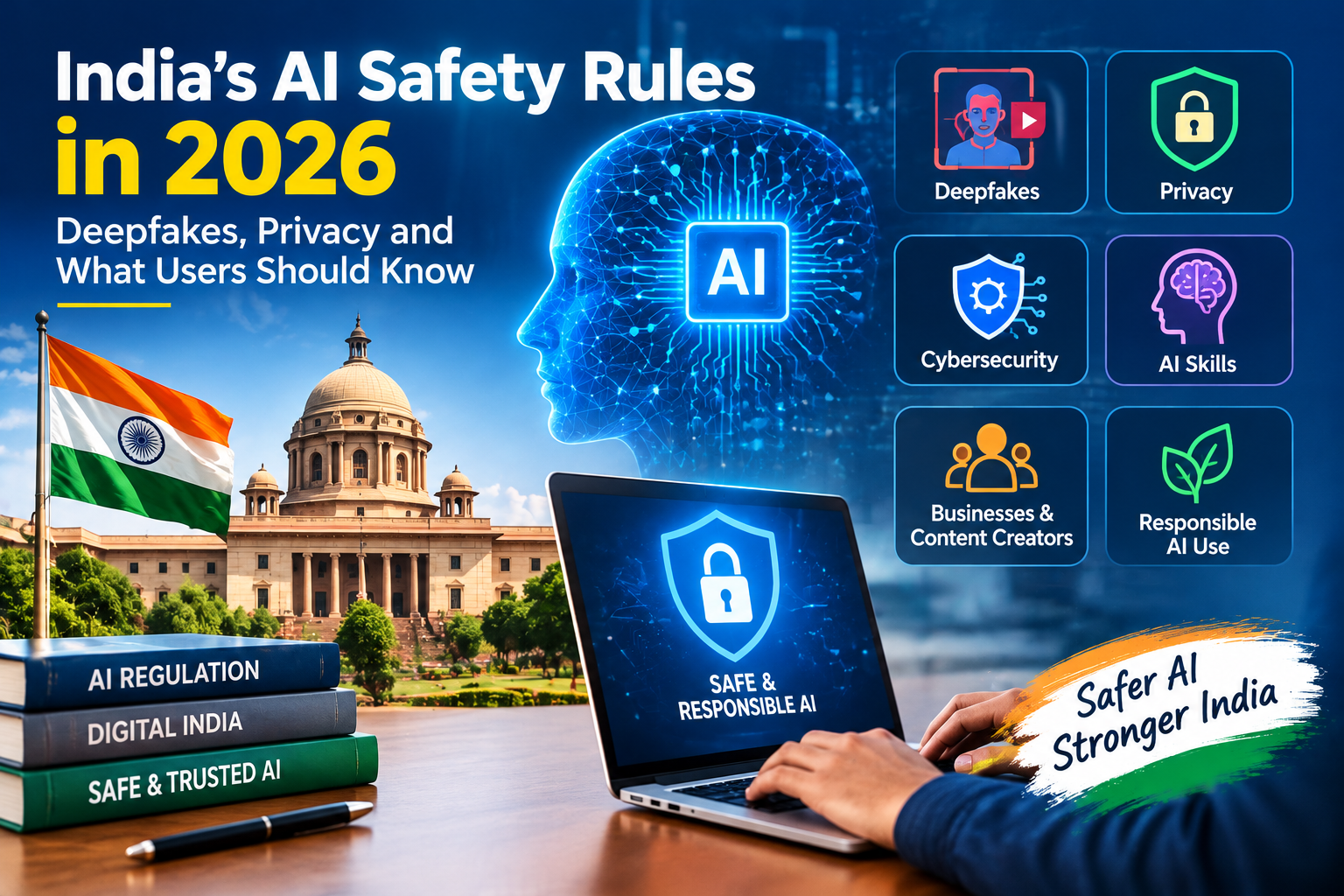
Artificial intelligence (AI) is changing how people work, learn, communicate and do business in India. AI tools can write articles, generate images, translate languages, answer questions and automate everyday tasks. However, the rapid growth of this technology has also raised concerns about fake videos, online fraud, privacy and the misuse of personal information.
In 2026, India is continuing discussions about how to manage the risks associated with artificial intelligence while supporting innovation. Proposed policy discussions cover issues such as AI safety, deepfakes, harm to users, cybersecurity and skill development. Any proposed measures should be distinguished from rules that have already been officially finalised.
This topic matters to technology companies, website owners, content creators and ordinary internet users. Understanding the risks can help people use AI more safely while keeping up with future policy developments.
What Are India’s AI Safety Rules in 2026?
India is considering how technology safeguards, existing laws and responsible industry practices can work together to address AI-related risks.
A government consultation paper can invite feedback from technology companies, experts and other stakeholders before further policy decisions are made. The precise requirements of any future framework will depend on official announcements and the outcome of that process.
Important areas of discussion include:
- AI safety and responsible use
- Deepfakes and misleading AI-generated content
- Cybersecurity and online harm
- Privacy and protection of personal information
- AI education and skill development
- Making the benefits of AI accessible to more people
People should check official government announcements for confirmed requirements rather than assuming that every proposed measure is already law.
1. Why Is India Focusing on AI Safety?
AI systems are becoming more capable, and their outputs can influence education, business, finance, healthcare and public communication.
AI can help people complete tasks faster, explain difficult subjects and analyse information. However, it can also generate inaccurate answers, create misleading content or be misused for fraud.
AI safety aims to reduce these risks while allowing useful applications to develop. For example, a business might use AI to assist customer support, but it should still check important answers and protect customers’ personal information.
2. Deepfakes: A Major Concern for Internet Users
A deepfake is audio, video or imagery created or manipulated with AI to make someone appear to say or do something that did not happen.
Deepfakes can be used for entertainment and creative projects, but they can also support impersonation, fraud, harassment and misinformation. A scammer might use a synthetic voice resembling a family member to request money, or a manipulated video might falsely attribute a statement to a public figure.
How Can You Protect Yourself From Deepfakes?
- Check surprising claims against trusted news sources.
- Look for the original source of a video or image.
- Verify unusual requests for money using another communication channel.
- Be cautious when a message creates panic or demands immediate action.
- Report suspected impersonation or harmful content to the relevant platform.
AI detection tools may help in some cases, but their results are not always reliable. Checking the source and context remains important.
3. AI, Privacy and Personal Data Protection
Many AI applications allow users to upload photographs, documents, recordings and other information. Before sharing such material, users should understand how the service handles their data.
Uploading identity documents, financial details, passwords, confidential company records or private customer information to an unfamiliar tool can create unnecessary risks.
Practical Privacy Tips
- Read the service’s privacy policy and review its data settings.
- Avoid uploading sensitive information unless it is necessary and appropriate.
- Use trusted services and secure your accounts with strong passwords.
- Enable two-factor authentication where available.
- Businesses should establish clear rules about the information employees can enter into AI tools.
India’s data-protection framework is also relevant to the handling of personal information. The specific legal obligations depend on the applicable laws, rules and circumstances.
4. Cybersecurity and AI-Powered Scams
AI can help organisations identify suspicious activity and improve security monitoring. However, criminals may also use AI to create convincing scam messages, imitate voices or build misleading websites.
Because AI-generated messages can look convincing, people should verify the identity of anyone requesting money, account access or confidential information.
- Never share banking PINs, passwords or one-time passwords with someone who contacts you unexpectedly.
- Check website addresses before entering personal information.
- Keep your devices, browsers and applications updated.
- Confirm changes to payment instructions through a trusted contact method.
- Report suspected fraud to the relevant platform or authority.
Businesses should train employees to recognise impersonation attempts and report potential cybersecurity incidents quickly. AI security tools can provide additional support, but they should not replace sound security practices.
5. How Could AI Regulations Affect Businesses?
Businesses in India are exploring AI for customer service, marketing, research, software development and data analysis. A clearer regulatory framework could help organisations understand how to manage risks and what responsibilities may apply to different AI applications.
The actual impact will depend on the final measures adopted. Businesses can prepare by reviewing how they use AI, identifying the information employees share with AI tools and checking whether staff have received suitable training.
Organisations should also review AI-generated content before using it in customer communications or important decisions. Responsible AI use can help protect a company’s reputation, maintain customer trust and reduce avoidable mistakes.
6. What Should Bloggers and Content Creators Know?
Website owners, bloggers, publishers and social media creators can use AI to brainstorm ideas, improve grammar, organise research and create illustrations. However, AI-generated material should be reviewed before publication because AI systems can produce incorrect facts, outdated information and misleading explanations.
Before publishing AI-assisted content, creators should:
- Verify important claims against reliable sources.
- Check names, dates, statistics and quotations.
- Add original explanations and useful examples.
- Avoid presenting illustrative AI images as genuine evidence.
- Correct errors when they are discovered.
For website owners who want to qualify for advertising, original value and reader usefulness are especially important. Publishing large quantities of unreviewed AI-generated content is not a good content strategy. AI should support research and editing, while human review ensures accuracy and usefulness.
7. AI Skills and Jobs in India
AI safety discussions also connect with the need to develop skills for a changing workplace. AI tools can help workers summarise documents, analyse data, draft reports and automate repetitive tasks.
Students and professionals can prepare by learning digital literacy, data analysis, cybersecurity basics and responsible AI use. Communication, critical thinking and problem-solving remain important because AI tools can make mistakes and may not understand every real-world situation.
Businesses can also benefit from training employees to use AI effectively rather than adopting tools without a clear plan. The long-term impact of AI on employment will vary across industries and occupations.
8. What Should Ordinary Users Do Right Now?
People do not need to stop using AI. Instead, they should understand its benefits and limitations.
- Check important AI-generated answers against trustworthy sources.
- Protect personal information when using AI applications.
- Verify surprising videos and audio recordings before sharing them.
- Be cautious with unfamiliar AI services and links.
- Do not rely on AI alone for high-stakes medical, legal or financial decisions.
Parents and teachers can help young people distinguish verified information from synthetic content. Businesses can introduce clear policies for safe and responsible AI use.
Conclusion
India’s AI safety discussions in 2026 reflect the growing need to balance technological progress with privacy, cybersecurity and public trust.
Policy consultations may help shape future decisions about deepfakes, user protection and responsible AI. However, proposed measures should not be confused with final legal requirements. Readers should check official government announcements for the latest confirmed information.
For individuals, practical steps include verifying suspicious content, protecting personal information and using AI responsibly. Businesses and content creators should review their AI practices and make fact-checking part of their normal workflow.
As AI becomes more common in everyday life, informed users and responsible organisations will be better prepared to benefit from the technology while reducing its risks.
Disclaimer: This article is for general informational purposes only and does not constitute legal advice.