Artificial intelligence is becoming an important skill for students preparing for future careers. From writing and research to software development and data analysis, AI tools are changing how people study and work.
On October 21, 2026, a report said Gujarat has prepared a draft proposal for an AI training mission aimed at students in higher education. The proposed Gujarat AI for Every Student Mission 2026–27 is designed to introduce students to AI fundamentals and help some learners develop more advanced, job-oriented skills.
The plan is still subject to the required government clearances. Students should therefore treat it as a proposed initiative rather than an already available course.
What Is Gujarat's Proposed AI Training Mission?
The proposed programme aims to expand AI education across higher education institutions in Gujarat. According to the report, it could reach five lakh students and train 5,000 faculty members as AI Master Trainers within 12 months.
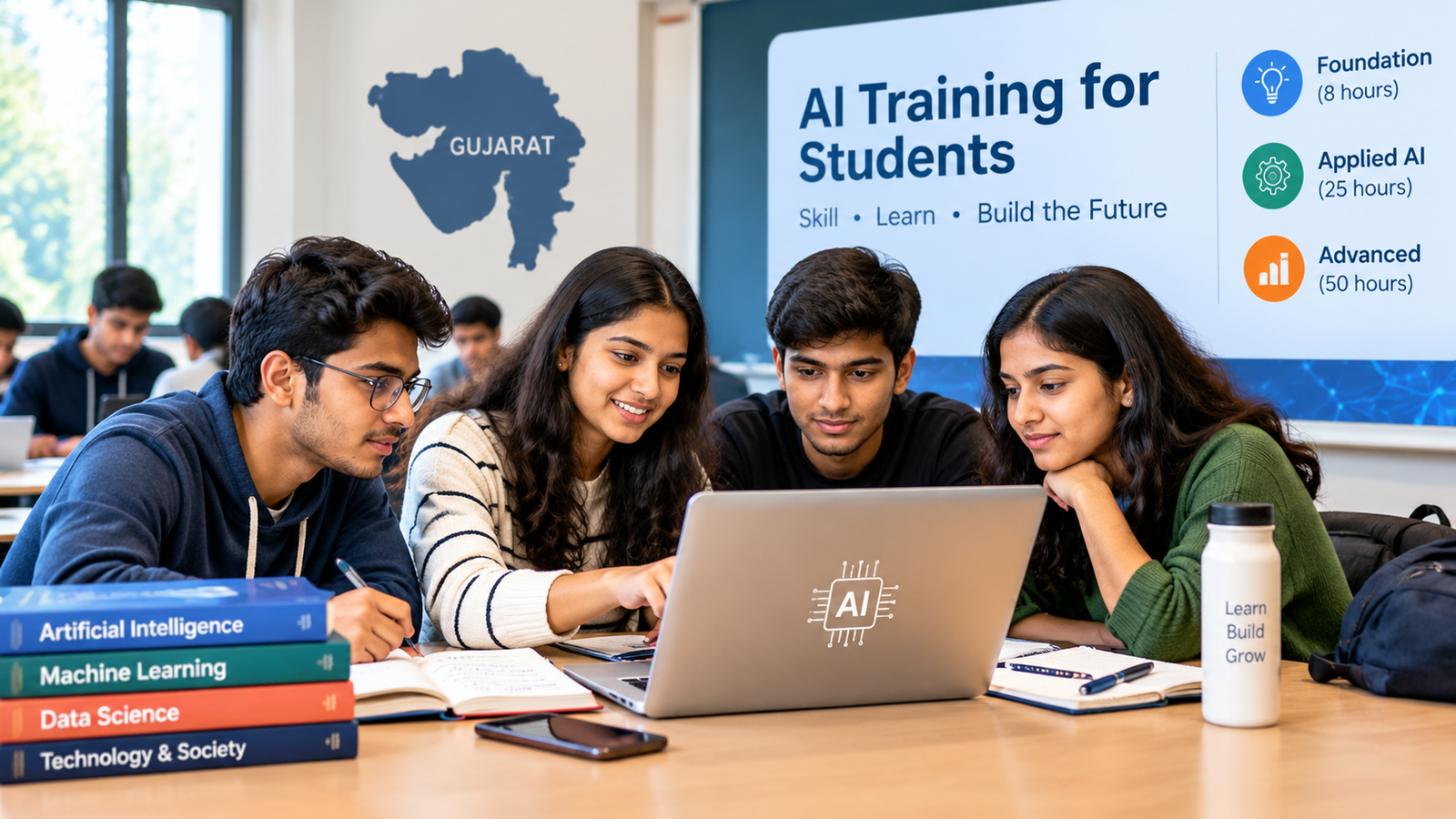
The reported draft outlines three levels of training, ranging from introductory AI awareness to advanced applications. The idea is to give students opportunities to understand artificial intelligence and explore how it can be applied in different fields.
For students, the important point is that learning AI should involve more than simply knowing how to use a chatbot. It should also include problem-solving, responsible use, fact-checking and practical experience.
Understanding the Three Proposed Levels of AI Training
1. Foundation Course
The proposed foundation level is reported to include an eight-hour course targeting five lakh students. An introductory course could help learners understand basic AI concepts, common applications and the limitations of AI-generated answers.
Students beginning their AI journey can focus on questions such as:
- What is artificial intelligence?
- How do AI chatbots and other AI tools work at a basic level?
- Where can AI be useful in education and everyday life?
- Why should AI-generated information be checked?
- What privacy risks should users understand?
2. Applied AI Course
The reported proposal includes a 25-hour applied AI course targeting one lakh learners. This level could help students explore practical uses of AI in their chosen subjects.
For example, business students might examine how AI supports data analysis, while computer science students could practise programming with AI assistance. Students in other disciplines could explore research support, document analysis or subject-specific applications.
Practical learning should include checking results, explaining decisions and completing tasks independently—not simply accepting whatever an AI tool produces.
3. Advanced and Employment-Oriented Training
The third reported level is a 50-hour advanced programme targeting 20,000 students. It is intended to focus on more advanced, employment-oriented skills.
Depending on the final curriculum, advanced AI learning may involve practical projects, data handling, automation, machine learning concepts or applying AI to problems in a particular industry.
Students should check the final syllabus, eligibility requirements, delivery method and any assessment or certification details when official information becomes available.
Why AI Skills Matter for College Students
AI literacy can help students prepare for workplaces where digital tools are increasingly common. Understanding AI also helps learners decide when a tool is useful and when human judgement is necessary.
Better Research and Problem-Solving
AI tools can help students generate research questions, organise ideas and understand difficult concepts. However, students should verify important claims using reliable sources and read the original material whenever possible.
Practical Digital Skills
Learning how to use digital tools effectively can complement subject knowledge. Students can practise writing clear instructions, reviewing AI output, organising information and identifying errors.
Career Exploration
AI knowledge may be relevant to careers in software, business, marketing, finance, design, research and many other fields. The skills required vary by role, so students should combine AI learning with strong fundamentals in their chosen discipline.
How Students Can Start Learning AI Now
Students do not need to wait for a new programme to begin building basic AI knowledge. These practical steps can help them get started.
- Learn the fundamentals: Understand what AI can do, how it can make mistakes and why its answers need evaluation.
- Practise with a real task: Use an AI tool to explain a difficult concept or help organise a study plan.
- Check the output: Compare important facts with textbooks, course materials or trusted sources.
- Build a small project: Create a simple research summary, data report, study resource or subject-related demonstration.
- Keep a record of your work: Document the problem, the tools used, the result and what you learned.
- Protect personal information: Avoid uploading private documents, passwords, financial details or confidential college information to AI services.
- Develop core skills: Continue improving communication, critical thinking, mathematics and subject knowledge.
How Teachers and Colleges Can Support AI Learning
Successful AI education requires more than access to software. Teachers need suitable training, students need opportunities to practise, and colleges need clear guidelines for responsible use.
Institutions can support learners by introducing practical assignments, encouraging students to explain their reasoning and setting clear rules for AI use in coursework. Assessments should measure understanding, not just the quality of a submitted answer.
Faculty training will also be important if the proposed mission proceeds. Teachers should be equipped to demonstrate appropriate AI use, identify inaccurate output and guide students in evaluating information.
Important Things Students Should Verify
Because the reported mission is a draft proposal, students should confirm details through official announcements before making decisions based on it.
- Whether the programme has received formal approval.
- Which colleges and universities will participate.
- Who can enrol and whether any fees apply.
- How students will access the courses.
- Whether assessments or certificates will be offered.
- When registration and training are expected to begin.
Do not assume that registration is open or that a certificate is guaranteed until the relevant authorities publish confirmed information.
Frequently Asked Questions
Has Gujarat officially launched the AI training mission?
A report dated October 21, 2026, described the mission as a draft proposal awaiting the required government clearances. Students should check official announcements for its current status.
How many students could benefit from the proposed programme?
The reported proposal aims to reach five lakh higher education students, with different targets for the applied and advanced training levels. These are proposed targets, not confirmation of enrolment.
Do students need coding knowledge to learn AI?
Not necessarily. Basic AI literacy can be learned without programming. More technical topics, such as machine learning development, may require programming, mathematics or other specialised knowledge.
Will AI skills guarantee a job?
No. AI knowledge can complement a student's qualifications, but employment depends on several factors, including practical ability, communication, subject expertise, experience and employer requirements.
Conclusion
Gujarat's proposed AI training mission could provide a structured way for higher education students to develop artificial intelligence skills if it receives approval and is implemented as described.
For now, students can prepare by learning AI fundamentals, practising with real tasks, checking information carefully and strengthening their core academic skills. The most valuable approach is to use AI as a learning assistant while continuing to think independently and solve problems themselves.
Sources and Further Reading
- The Times of India: Gujarat proposes three-tier AI training for 5 lakh students
- Press Information Bureau: National Education Policy 2020 and skill-based learning
Related reading: How to Use AI Safely and How to Take Better Notes.