Artificial intelligence is no longer only about chatbots and AI applications. Behind every modern AI system is a large infrastructure layer made up of semiconductors, data centers, networking equipment, cloud platforms, storage, and electricity.
As AI systems become more capable and businesses use them for more tasks, the infrastructure supporting AI is becoming increasingly important. In 2026, companies are investing not only in AI models and applications but also in the computing capacity needed to run them.
This guide explains what AI infrastructure means, why AI chips matter, how data centers support modern AI, why energy is becoming an important part of the discussion, and what businesses should understand about the technology behind today's AI boom.
Table of Contents
- What Is AI Infrastructure?
- Why AI Chips Matter
- The Role of Data Centers
- Cloud Computing and AI
- Why Networking Matters
- AI and Electricity Demand
- What AI Infrastructure Means for Businesses
- AI Infrastructure and India
- What Could Come Next?
- Frequently Asked Questions
What Is AI Infrastructure?
AI infrastructure is the hardware and software required to develop, train, deploy, and operate artificial intelligence systems.
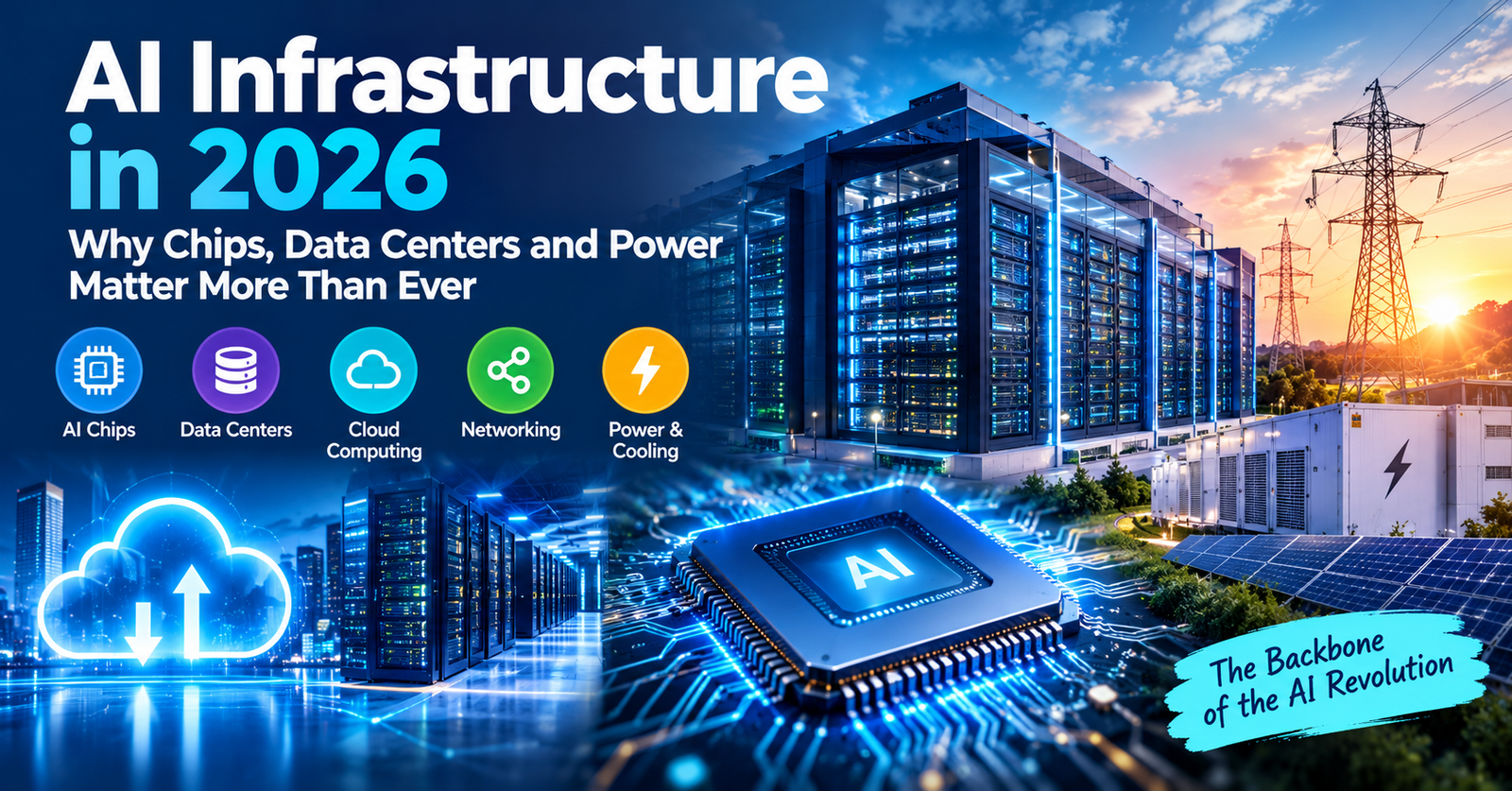
It includes several important components:
- AI accelerators and processors
- Servers and computing systems
- Data centers
- Cloud computing platforms
- High-speed networking
- Data storage
- Cooling systems
- Electricity and power infrastructure
- AI software and model platforms
Without this infrastructure, even the most advanced AI model would not be able to operate at large scale.
Why AI Chips Matter
AI workloads require substantial computing power. Specialized processors can perform the mathematical operations used by machine-learning systems much more efficiently than general-purpose computing alone.
Graphics processing units, AI accelerators, and other specialized chips are therefore an important part of modern AI infrastructure.
The semiconductor industry is also developing new processor architectures designed for different AI workloads, from training large models to running AI applications closer to users.
This means the future of AI depends not only on better software but also on continued innovation in semiconductor technology.
The Role of Data Centers
Data centers provide the physical environment where many AI workloads run. They contain servers, networking equipment, storage systems, cooling infrastructure, and power systems.
Training and operating large AI models can require substantial computing capacity. As AI adoption expands, companies need access to infrastructure that can handle these workloads efficiently.
Modern data centers are therefore becoming an important part of the AI ecosystem.
What Makes an AI Data Center Different?
AI workloads can create different infrastructure requirements from traditional computing workloads.
Large numbers of specialized processors may need to communicate rapidly with one another. This increases the importance of high-speed networking, efficient cooling, storage, and power management.
Cloud Computing and AI
Cloud computing gives businesses access to computing resources without requiring every company to build its own data center.
Businesses can use cloud services for AI model development, data processing, application hosting, and other workloads.
For smaller companies, cloud infrastructure can make it easier to experiment with AI without making a large upfront investment in physical computing equipment.
However, organizations still need to consider cloud costs, data privacy, security, performance, and vendor dependence when choosing an AI infrastructure strategy.
Why Networking Matters
AI infrastructure is not only about processors.
Large computing systems need high-speed connections between processors, servers, storage systems, and other components.
Fast networking can help move large amounts of data between different parts of an AI system and can be particularly important when many processors are working together.
As AI computing becomes more distributed, networking technology is likely to remain an important part of infrastructure planning.
AI and Electricity Demand
Electricity is another important part of AI infrastructure.
Data centers require power not only for computing equipment but also for cooling and other supporting systems.
As organizations build more AI computing capacity, access to reliable and affordable electricity becomes an important infrastructure consideration.
This is one reason AI infrastructure is increasingly connected to discussions about energy generation, transmission networks, cooling technology, and data center locations.
What AI Infrastructure Means for Businesses
Businesses do not necessarily need to build their own AI data centers to benefit from artificial intelligence.
Many companies can use existing cloud platforms and AI services. Nevertheless, understanding infrastructure can help businesses make better technology decisions.
Cost
AI applications can have different computing requirements. Businesses should consider both software costs and the computing resources required to operate AI systems.
Performance
Some applications need fast responses, while others can process information in batches. The infrastructure choice can affect performance.
Security
Businesses should understand where their AI data is processed and what security controls are available.
Scalability
An AI application that works for 100 users may require a different infrastructure strategy when it grows to thousands or millions of users.
AI Infrastructure and India
India is also developing its semiconductor and digital infrastructure capabilities.
The country's semiconductor ambitions include expanding domestic manufacturing and building a broader ecosystem around chip production.
This matters for AI because advanced computing depends on a global supply chain involving semiconductors, equipment, software, cloud infrastructure, and data centers.
India's growing technology sector also creates opportunities for engineers, developers, data professionals, semiconductor specialists, and infrastructure experts.
For readers interested in India's semiconductor development, see our related article: India Semiconductor Mission 2026: What Semicon 2.0 Means for Chip Manufacturing .
AI Infrastructure vs AI Applications
| AI Infrastructure | AI Applications |
|---|---|
| Processors and accelerators | AI assistants |
| Data centers | Chatbots |
| Cloud computing | AI business software |
| Networking | AI search and productivity tools |
| Storage | Generative AI applications |
| Power and cooling | AI-powered services |
What Could Come Next?
The AI infrastructure industry is continuing to evolve.
Future developments could include more specialized processors, improved energy efficiency, new data center designs, faster networking, and greater use of AI computing closer to where data is generated.
McKinsey's 2026 Technology Trends Outlook highlights AI infrastructure and model architectures as one of the major technology areas shaping the year. The report also identifies agentic software development and AI for scientific discovery and engineering among emerging areas receiving significant attention.
This suggests that AI infrastructure should be viewed as more than a background technology. It is becoming a fundamental part of the digital systems used to build and operate modern AI.
How AI Infrastructure Could Affect Everyday Technology
AI infrastructure may sound like a topic that only matters to large technology companies, but its effects can reach everyday users.
- Faster AI assistants
- More AI features in smartphones and computers
- AI-powered business applications
- Improved cloud services
- More intelligent search tools
- AI-powered cybersecurity systems
- New automation products
As computing becomes more efficient and AI services become easier to access, more software products may incorporate AI capabilities.
What Businesses Should Watch in 2026
- AI computing costs
- Cloud infrastructure pricing
- AI chip developments
- Data center expansion
- Energy availability
- AI security requirements
- Data privacy regulations
- New AI infrastructure platforms
Businesses do not need to follow every infrastructure development, but understanding these trends can help technology leaders make better long-term decisions.
Frequently Asked Questions
What is AI infrastructure?
AI infrastructure is the combination of hardware, software, networking, storage, data centers, power systems, and other technologies required to develop and operate artificial intelligence systems.
Why are AI chips important?
AI chips and accelerators are designed to efficiently handle the mathematical workloads involved in many artificial intelligence applications.
Do small businesses need their own AI data center?
Usually not. Many small businesses can use cloud-based AI services instead of building their own physical infrastructure.
Why does AI require so much infrastructure?
Large AI workloads can require significant computing, networking, storage, cooling, and electricity. The exact requirements vary depending on the model and application.
Is AI infrastructure important for the future of technology?
AI infrastructure is an important part of the current AI ecosystem. As AI applications expand, computing, semiconductor, networking, data-center, and energy infrastructure will remain important supporting technologies.
Final Thoughts
AI infrastructure is becoming one of the most important layers behind the rapid development of artificial intelligence.
The AI experience that users see on a screen depends on a much larger system of processors, data centers, networks, storage, software, cooling, and electricity.
For businesses and technology professionals, understanding this infrastructure can provide useful context for the opportunities and challenges surrounding AI in 2026.
AI may be the visible part of the technology revolution, but the infrastructure underneath it is what makes much of that revolution possible.
Sources
About WriteHubDaily
WriteHubDaily publishes practical articles about artificial intelligence, technology, productivity, business, digital trends, travel, and useful everyday knowledge.