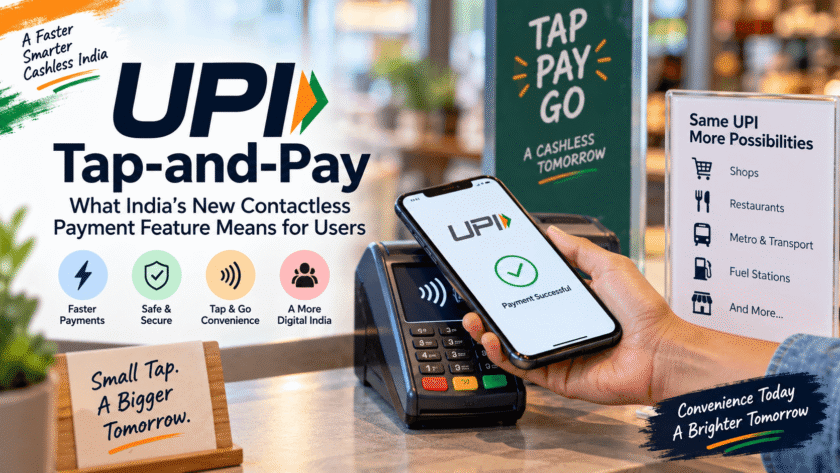
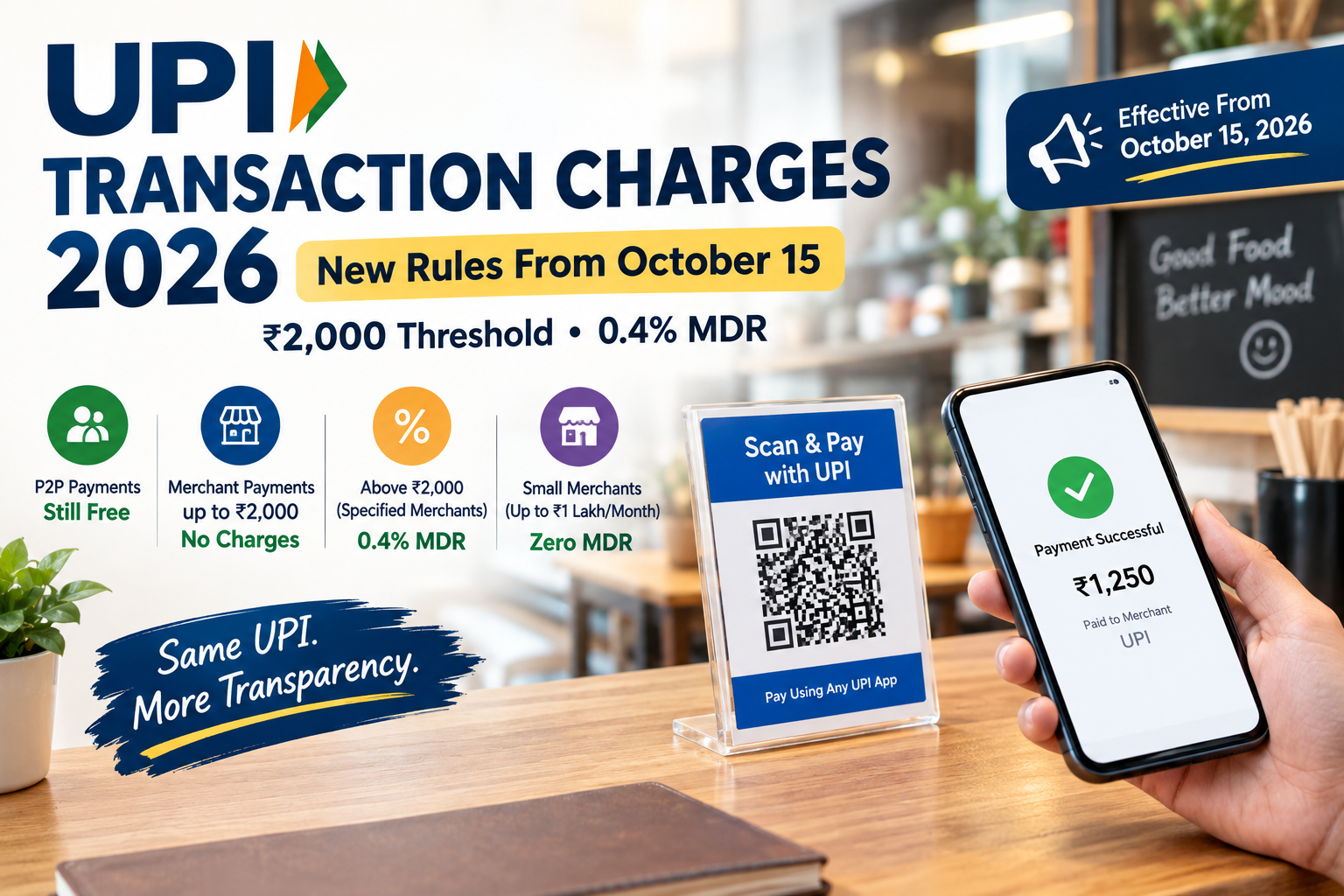
UPI transaction charges 2026 are changing from October 15, 2026, with a new Merchant Discount Rate (MDR) framework for certain merchant payments. However, the new rules do not mean that customers will have to pay a new UPI transaction fee.
Under the revised framework announced by the National Payments Corporation of India (NPCI), a 0.4% MDR will apply to specified person-to-merchant (P2M) UPI transactions above ₹2,000. The MDR is a charge within the merchant payment ecosystem and is not a direct customer fee.
The new framework is scheduled to take effect from October 15, 2026. Here is what consumers, merchants and small businesses need to know about the new UPI rules.
UPI Transaction Charges 2026: What Is Changing?
The main change is the introduction of MDR on specified person-to-merchant UPI payments above ₹2,000.
Under the new framework, eligible P2M transactions above ₹2,000 will attract an MDR of 0.4%. For transactions of ₹75,000 or more, the MDR will be capped at ₹300 per transaction.
This does not apply to every UPI transaction. Person-to-person payments remain outside the MDR framework, while merchant payments up to ₹2,000 also remain free of MDR.
Will Customers Have to Pay UPI Charges?
No. The revised MDR is not a direct charge on customers making UPI payments.
The government has clarified that banks have been advised to ensure merchants do not pass MDR charges on to customers for UPI payments. UPI application providers are also prohibited from imposing platform fees or hidden charges under the framework.
Therefore, customers should not assume that a ₹10,000 UPI payment will automatically cost them an additional ₹40.
The MDR is part of the merchant payment ecosystem and is distributed among participating entities such as banks, payment service providers and UPI application providers.
UPI Payments Up to ₹2,000 Will Remain Free
One of the most important points in the UPI transaction charges 2026 rules is the ₹2,000 threshold.
Person-to-merchant UPI payments of up to ₹2,000 will continue to remain free of MDR.
This means customers can continue using UPI for many everyday purchases without an MDR being applied to the merchant payment.
The government has stated that approximately 96% of P2M UPI transactions will remain unaffected because they are either below the ₹2,000 threshold or covered by the zero-MDR framework for small merchants.
What Is the 0.4% MDR on UPI?
MDR stands for Merchant Discount Rate. It is a charge associated with processing certain merchant payments.
From October 15, 2026, the standard MDR for specified P2M UPI transactions above ₹2,000 will be 0.4%.
For example:
| Eligible UPI payment | 0.4% MDR calculation |
|---|---|
| ₹5,000 | ₹20 |
| ₹10,000 | ₹40 |
| ₹25,000 | ₹100 |
| ₹50,000 | ₹200 |
| ₹75,000 | ₹300 |
| ₹1,00,000 | ₹300 maximum due to the cap |
These figures show the MDR calculation within the payment ecosystem. They should not be interpreted as an additional amount that the customer must pay.
What Is the Maximum UPI MDR?
For specified P2M transactions of ₹75,000 and above, the MDR will be capped at ₹300 per transaction.
For example, a transaction of ₹75,000 would have a calculated MDR of ₹300 at 0.4%. A transaction of ₹1 lakh would normally calculate to ₹400 at 0.4%, but the ₹300 cap means the applicable MDR would not exceed ₹300 under the standard framework.
What About UPI Payments Between Friends and Family?
There is no change to ordinary person-to-person (P2P) UPI transactions.
Sending money to a friend, family member or another individual through UPI will remain completely free, regardless of the amount transferred. The government has specifically stated that P2P transactions remain outside the MDR framework.
This means the new UPI transaction charges 2026 rules should not be confused with a charge on ordinary money transfers between individuals.
Small Merchants Will Continue to Get Zero MDR
The revised framework includes protection for eligible small merchants.
Small merchants, including street vendors and neighbourhood shops, receiving up to ₹1 lakh per month through UPI QR codes under the specified Person-to-Person-Merchant (P2PM) category will continue to receive zero MDR on their transactions.
This provision is designed to prevent additional payment costs from affecting small businesses that rely on digital payments.
Special ₹5 MDR for Essential Sectors
Certain essential and thin-margin sectors will have a different MDR structure.
Eligible transactions above ₹2,000 in sectors including railways, telecommunications, insurance, fuel and agricultural inputs will attract a flat ₹5 MDR per transaction.
| Sector | Eligible transaction above ₹2,000 |
|---|---|
| Railways | ₹5 flat MDR |
| Telecommunications | ₹5 flat MDR |
| Insurance | ₹5 flat MDR |
| Fuel | ₹5 flat MDR |
| Agricultural inputs | ₹5 flat MDR |
What About Mutual Funds and Stock Market Payments?
The new framework also provides a separate rate for certain capital-market-related payments.
Payments relating to mutual funds, securities, stockbrokers and dealers will attract an MDR of 0.02%, capped at ₹300 per transaction.
This is different from the standard 0.4% MDR applicable to specified merchant transactions above ₹2,000.
When Will the New UPI Rules Start?
The revised UPI MDR framework is scheduled to take effect on:
October 15, 2026
The NPCI issued its detailed circular on September 15, 2026, following deliberations by the UPI Steering Committee.
UPI Transaction Charges 2026: What Changes for Regular Users?
For most regular UPI users, the main points are straightforward:
- Person-to-person UPI payments remain free.
- Merchant payments up to ₹2,000 remain free of MDR.
- Specified merchant payments above ₹2,000 will attract MDR.
- The standard MDR for eligible P2M payments is 0.4%.
- The MDR is capped at ₹300 for transactions of ₹75,000 and above.
- Eligible small merchants can continue to receive zero-MDR benefits.
- Customers are not required to pay the MDR.
- UPI apps cannot impose hidden platform fees under the announced framework.
The government says approximately 96% of merchant UPI transactions will remain unaffected by the new MDR framework.
Example: ₹10,000 UPI Payment
Suppose you purchase a product from a merchant for ₹10,000 and pay using UPI.
Because the transaction is above ₹2,000, it may fall under the specified P2M MDR framework.
At 0.4%, the MDR calculation would be:
₹10,000 × 0.4% = ₹40
However, this ₹40 is an MDR within the merchant payment ecosystem. It is not a ₹40 customer transaction fee.
The government has stated that merchants should not pass the MDR charge to customers for UPI payments.
Example: ₹2,000 UPI Payment
If you make a merchant payment of exactly ₹2,000 through UPI, the transaction remains free of MDR under the new framework.
The new standard MDR applies to specified merchant transactions above ₹2,000.
Example: ₹75,000 UPI Payment
For a specified eligible P2M transaction of ₹75,000:
₹75,000 × 0.4% = ₹300
The ₹300 amount also represents the cap for the standard MDR framework at ₹75,000 and above.
Does the New Rule Mean UPI Is No Longer Free?
Not for all transactions.
The new framework creates an MDR for specified merchant payments above ₹2,000, but several categories remain free.
According to the Ministry of Finance, all P2P UPI transactions remain completely free, merchant payments up to ₹2,000 remain free, and eligible small merchants continue to receive zero-MDR treatment.
Therefore, it is more accurate to describe the change as a new MDR framework for selected merchant transactions rather than a general UPI transaction fee.
Why Has NPCI Introduced the New MDR Framework?
The government says the framework is intended to support the long-term sustainability and continued expansion of the UPI ecosystem while protecting individuals and small merchants from additional charges.
The MDR collected within the merchant payment ecosystem will be distributed among participating entities, including banks, payment service providers and UPI application providers.
The framework also keeps protections for low-value payments and eligible small merchants.
UPI Transaction Charges 2026: Key Points at a Glance
| UPI transaction type | Rule from October 15, 2026 |
|---|---|
| Person-to-person payment | Free |
| Merchant payment up to ₹2,000 | Free of MDR |
| Specified merchant payment above ₹2,000 | 0.4% MDR |
| Specified transaction of ₹75,000 or more | MDR capped at ₹300 |
| Eligible small merchants | Zero MDR under the P2PM framework |
| Essential sectors above ₹2,000 | ₹5 flat MDR |
| Capital-market transactions | 0.02% MDR, capped at ₹300 |
Frequently Asked Questions About UPI Charges 2026
Will UPI become paid from October 15, 2026?
No. UPI will not become a paid service for all users. Person-to-person transactions remain free, and merchant payments up to ₹2,000 remain free of MDR. The new MDR applies to specified merchant transactions above ₹2,000.
Will customers pay the 0.4% UPI charge?
No. The 0.4% MDR is a merchant-side charge within the payment ecosystem. Banks have been advised to ensure that merchants do not pass the MDR on to customers for UPI payments.
What is the UPI transaction limit for the new MDR?
The new standard MDR applies to specified person-to-merchant transactions above ₹2,000. For transactions of ₹75,000 and above, the MDR is capped at ₹300.
Are UPI payments between friends free?
Yes. Person-to-person UPI transactions remain completely free regardless of the amount transferred.
Are payments below ₹2,000 free?
Yes. Merchant payments up to ₹2,000 remain free of MDR under the new framework.
Do small merchants have to pay MDR?
Eligible small merchants receiving up to ₹1 lakh per month through UPI QR codes under the specified P2PM category will continue to receive zero-MDR treatment.
When will the new UPI MDR rules start?
The revised framework is scheduled to take effect on October 15, 2026.
Final Takeaway
The UPI transaction charges 2026 changes introduce a new MDR framework for specified merchant payments above ₹2,000 from October 15, 2026.
The standard MDR is 0.4%, with a maximum of ₹300 for transactions of ₹75,000 and above. However, this is not a direct customer fee.
Person-to-person UPI payments remain free, merchant payments up to ₹2,000 remain free, and eligible small merchants continue to receive zero-MDR benefits.
For regular UPI users, the most important point is simple: the new MDR should not be confused with a new charge that customers must pay when using UPI.