
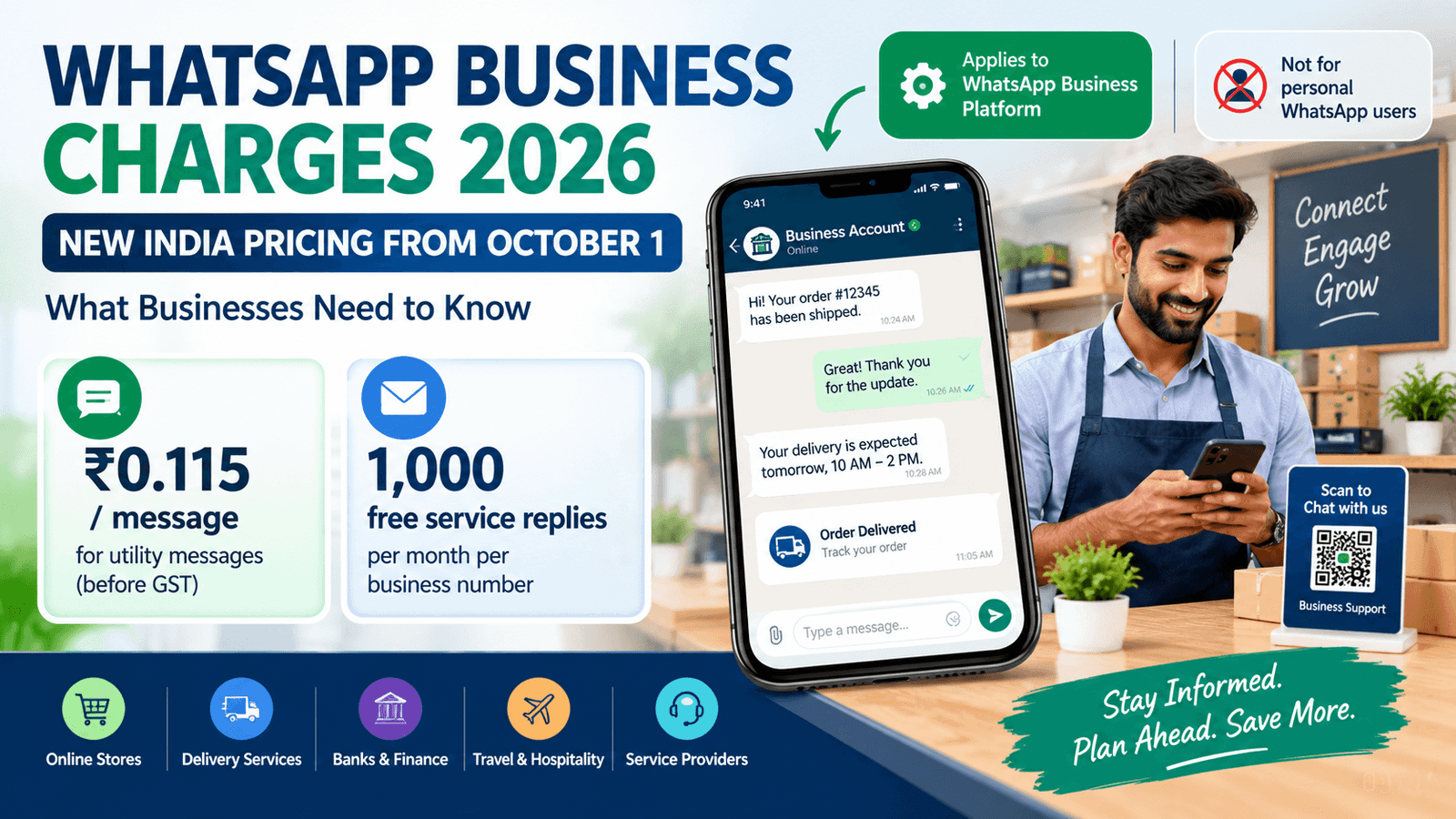
WhatsApp Business charges 2026 have changed in India from October 1, affecting businesses that use the WhatsApp Business Platform to communicate with customers. The new pricing introduces charges for certain service and utility messages that were previously available under free messaging conditions.
The change is particularly important for online stores, delivery companies, banks, travel businesses, service providers and other companies that use WhatsApp for customer communication.
What Changed in WhatsApp Business Pricing?
Meta has changed how it charges businesses for messages sent through the WhatsApp Business Platform.
Previously, some customer-service and utility messages could be sent without an additional message charge when they were sent during an open 24-hour customer service window.
From October 1, 2026, businesses can be charged for certain utility messages and service messages, depending on the message category and the applicable pricing structure.
Does This Affect Normal WhatsApp Users?
No. The pricing change is aimed at businesses using the WhatsApp Business Platform.
Regular WhatsApp users do not have to pay Meta to send messages to businesses or receive replies from them.
The WhatsApp Business app used by many small businesses is also different from the API-based WhatsApp Business Platform covered by these pricing changes.
How Much Does WhatsApp Business Messaging Cost in India?
According to reports on Meta's revised India pricing, utility messages are charged at around ₹0.115 per delivered message before GST.
For example, if a business sends 1,000 chargeable utility messages, the base messaging cost would be approximately ₹115 before GST.
The exact amount can vary depending on the message category and the applicable WhatsApp Business pricing structure.
What Are Utility Messages?
Utility messages are business communications connected to a customer's transaction or request.
- Order confirmations
- Delivery updates
- Booking confirmations
- Payment-related notifications
- Account or service updates
- Other transaction-related customer notifications
These messages are different from promotional marketing messages, which have separate pricing.
What About Customer Service Replies?
Meta's revised structure also introduces a monthly free allowance for certain service replies.
Businesses receive 1,000 free service messages per month for each business phone number. After that allowance is used, additional service messages can become chargeable.
This means smaller businesses with limited customer-service conversations may see a smaller impact than businesses handling thousands of customer interactions every month.
WhatsApp Marketing Messages Are Different
Marketing messages are treated separately from service and utility communications.
Businesses that send promotional offers, sale announcements or other marketing campaigns should therefore check the current WhatsApp Business pricing for their market before planning large campaigns.
Marketing message costs can be considerably different from utility and authentication messages.
What Businesses Should Do Now
Businesses using WhatsApp for customer communication should review their messaging volume and categories.
- Check which WhatsApp Business Platform account you are using.
- Review your monthly message volume.
- Separate marketing, utility and service messages.
- Check your payment method and billing settings.
- Review automated order and delivery notifications.
- Calculate the expected monthly messaging cost.
- Remove unnecessary automated messages.
Small Businesses May Need to Review Their Costs
For a small company sending only a few hundred customer messages, the financial impact may be relatively limited.
However, businesses sending tens of thousands or millions of notifications every month should calculate the change carefully.
For example, an e-commerce company that sends order confirmations, delivery updates and customer-service messages at high volume could see its communication expenses increase.
Will Customers Have to Pay?
No. Customers do not directly pay WhatsApp for receiving business messages.
The charges are applied to businesses using the WhatsApp Business Platform.
This means customers can continue using WhatsApp to communicate with businesses without receiving a separate WhatsApp messaging bill.
Why Businesses Use WhatsApp Despite the Charges
WhatsApp remains an important customer communication channel because businesses can use it for order updates, support, bookings, notifications and customer engagement.
The new pricing therefore does not necessarily mean businesses will stop using WhatsApp. Instead, companies may become more selective about which automated messages they send.
WhatsApp Business Charges 2026: Key Points
- New WhatsApp Business Platform pricing applies from October 1, 2026.
- The change targets businesses using the WhatsApp Business Platform.
- Regular WhatsApp users are not directly charged.
- Some utility messages are now chargeable.
- Certain service messages have a 1,000-message monthly free allowance.
- Marketing messages have separate pricing.
- Businesses should review automated messaging volume and costs.
Frequently Asked Questions
Do normal WhatsApp users have to pay?
No. The pricing changes are for businesses using the WhatsApp Business Platform.
Are WhatsApp Business messages completely paid now?
No. Different message categories have different pricing rules and some service messages have a monthly free allowance.
Will small businesses be affected?
It depends on how much they use the WhatsApp Business Platform. Businesses with low messaging volumes may see a smaller impact.
Should businesses review their WhatsApp costs?
Yes. Businesses using automated notifications and customer-service messaging should review their message categories, monthly volume and current Meta pricing.
More Practical Guides from WriteHubDaily
- 10 Simple Ways to Make Your Small Business More Productive in 2026
- How AI Can Help Small Businesses Save Time and Money
- How to Be More Productive: 10 Simple Habits That Actually Work in 2026
- AI Infrastructure in 2026: Why Chips, Data Centers and Power Matter More Than Ever
Sources and Disclaimer
This article is based on reports about Meta's WhatsApp Business Platform pricing changes in India. Pricing and messaging policies can change, so businesses should check the latest information available from Meta before making financial or operational decisions.