
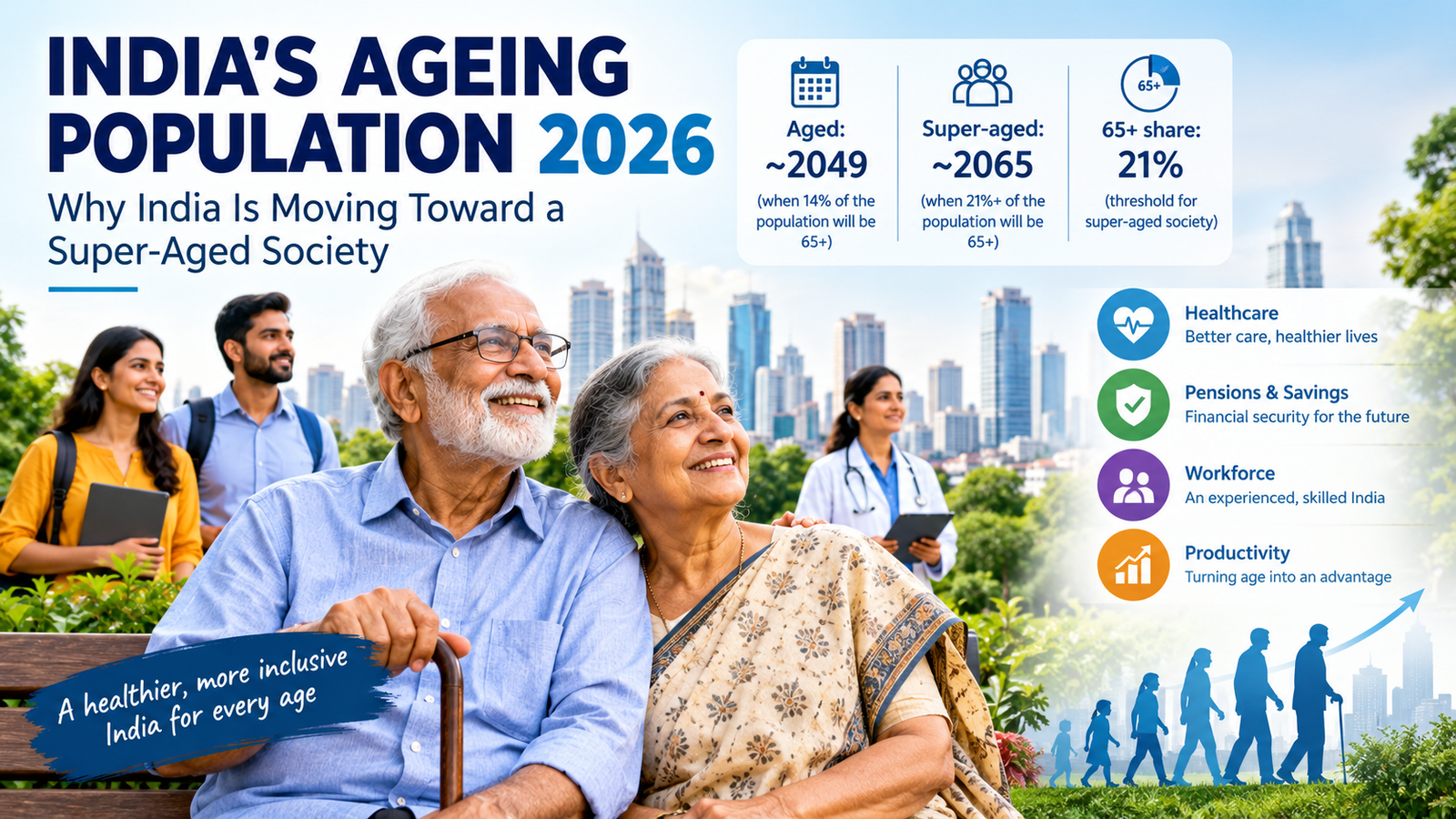
India ageing population 2026 is becoming an increasingly important demographic and economic issue. Although India remains relatively young compared with many developed countries, its age structure is changing as fertility rates fall and life expectancy increases.
A new analysis from Moody's Ratings says India could move from an "aged" society to a "super-aged" society in roughly 16 years. India entered the ageing category around 2024, is projected to reach the "aged" category around 2049 and could reach the "super-aged" threshold around 2065. :contentReference[oaicite:2]{index=2}
This demographic shift could affect healthcare, pensions, employment, financial planning, businesses and government policy over the coming decades.
What Does an Ageing or Super-Aged Society Mean?
The terms are based on the percentage of a country's population aged 65 and above.
| Category | Population aged 65+ | India's projected timeline |
|---|---|---|
| Ageing | 7% or more | Around 2024 |
| Aged | 14% or more | Around 2049 |
| Super-aged | 21% or more | Around 2065 |
These timelines are projections rather than fixed dates. They illustrate how quickly India's age structure could change if current demographic trends continue. :contentReference[oaicite:3]{index=3}
India's Elderly Population Is Already Growing
The ageing trend is also visible in India's own population projections.
According to the Government of India's Press Information Bureau, the population aged 60 years and above is projected to increase from about 10 crore in 2011 to 23 crore by 2036. Its share of India's total population is projected to rise from 8.4% to 14.9% during the same period. :contentReference[oaicite:4]{index=4}
At the same time, the share of people below 15 years is projected to decline from 30.9% in 2011 to 20.1% in 2036, reflecting India's broader demographic transition. :contentReference[oaicite:5]{index=5}
Why Is India's Population Ageing?
One of the main reasons is declining fertility.
Moody's reports that India's fertility rate has already fallen below the replacement level of 2.1 children per woman. Lower fertility means that younger age groups can become smaller over time, while the proportion of older people increases. :contentReference[oaicite:6]{index=6}
Other factors include increasing life expectancy, higher education levels, changing family patterns and the rising cost of housing, childcare, education and healthcare.
India's Demographic Dividend Is Changing
For decades, India's large working-age population has been an important economic advantage. A large workforce can support production, consumption, entrepreneurship and tax revenues.
However, the demographic picture is gradually changing.
The Economic Survey 2025-26 notes that India's demographic dividend is expected to peak around 2030, when nearly 65% of the population is projected to be in the 15-to-59 age group. At the same time, falling fertility and increasing life expectancy are contributing to population ageing. :contentReference[oaicite:7]{index=7}
This means India has an opportunity to benefit from its working-age population while also preparing for a future with a larger elderly population.
What Could Population Ageing Mean for Jobs?
A smaller proportion of working-age people can eventually create pressure on labour supply.
Moody's has highlighted that fewer workers could limit productive capacity as demographic ageing progresses. It also expects countries with ageing populations to rely increasingly on productivity to maintain economic growth. :contentReference[oaicite:8]{index=8}
For India, this could increase the importance of:
- Worker productivity
- Automation and technology
- Artificial intelligence
- Skills development
- Higher workforce participation
- Flexible working arrangements
- Longer and healthier working lives
Female Workforce Participation Could Become More Important
Increasing participation in the workforce is one possible way to expand India's available labour supply.
Moody's reported a female labour-force participation rate of 32% for India in its comparison of 19 economies and identified this as an area with scope for improvement. :contentReference[oaicite:9]{index=9}
However, India's official labour-force data has also shown improvement. The July 2026 Periodic Labour Force Survey reported an overall female labour-force participation rate of 34.4% for people aged 15 years and above, up from 32.7% in June 2026. :contentReference[oaicite:10]{index=10}
The difference between these figures reflects different datasets, definitions and reference periods, so they should not be treated as directly interchangeable.
Healthcare Will Become More Important
A larger elderly population can increase demand for healthcare and long-term care.
Older adults may require more frequent medical care, chronic disease management, rehabilitation and support services. This could create opportunities as well as challenges for India's healthcare system.
The Government of India says it has expanded Ayushman Bharat PM-JAY to provide health cover of ₹5 lakh per year to senior citizens aged 70 years and above, irrespective of socioeconomic status. The government is also implementing the National Programme for Health Care of the Elderly. :contentReference[oaicite:11]{index=11}
Pensions and Retirement Planning Could Change
Population ageing also has implications for retirement planning.
As the number of older people increases, demand for pensions, savings products, insurance and retirement income planning could grow.
India already operates schemes such as the Atal Pension Yojana, while government programmes also provide financial and social assistance to eligible senior citizens. :contentReference[oaicite:12]{index=12}
For individuals, the demographic trend highlights the importance of thinking about retirement savings, healthcare expenses and long-term financial security earlier in life.
How Businesses Could Be Affected
Population ageing will not only affect governments and healthcare providers. Businesses may also need to adapt to changing customer needs.
As the number of older households increases, businesses could see growing demand for products and services related to:
- Healthcare
- Senior living
- Insurance
- Retirement planning
- Financial services
- Home healthcare
- Mobility
- Accessible technology
- Travel and leisure
- Wellness and preventive healthcare
Companies may also need to consider older workers and customers when designing workplaces, products and digital services.
Technology Could Help India Adapt
Technology cannot stop demographic ageing, but it could help India manage some of its effects.
Artificial intelligence, automation and digital healthcare could improve productivity and help organisations deliver services with fewer workers.
For example, technology could support:
- Remote healthcare consultations
- AI-assisted medical screening
- Digital financial services
- Home monitoring devices
- Assistive technologies
- Automation in manufacturing
- AI-powered customer support
- Online education and skills training
Moody's notes that policy and technology can help societies adjust to ageing, although they cannot reverse the underlying demographic trend. :contentReference[oaicite:13]{index=13}
What Does This Mean for Younger Indians?
India's ageing trend is not only an issue for today's senior citizens. It will also affect younger generations.
Today's workers may eventually live longer and spend more years in retirement. That could make retirement savings, healthcare planning and continuous skills development increasingly important.
Younger workers may also have opportunities in sectors created or expanded by demographic change, including healthcare technology, senior care, insurance, financial planning, home services and assistive technology.
India Has Time to Prepare
India's demographic transition will happen gradually rather than overnight.
The country still has a large working-age population and a significant demographic opportunity. The Economic Survey expects India's demographic dividend to remain an important factor around 2030. :contentReference[oaicite:14]{index=14}
At the same time, the projected increase in the elderly population means preparation cannot be delayed indefinitely.
Improving healthcare infrastructure, retirement systems, skills, productivity, employment opportunities and age-friendly services can help India adapt as its population structure changes.
India Ageing Population 2026: Key Numbers
| Indicator | Figure |
|---|---|
| Ageing threshold | 7% of population aged 65+ |
| Aged threshold | 14% of population aged 65+ |
| Super-aged threshold | 21% of population aged 65+ |
| India entered ageing category | Around 2024 |
| Projected aged category | Around 2049 |
| Projected super-aged category | Around 2065 |
| Population aged 60+ in 2011 | About 10 crore |
| Projected population aged 60+ in 2036 | About 23 crore |
The figures above come from Moody's projections and Government of India population projections, which use different age definitions and reference periods. :contentReference[oaicite:15]{index=15}
Frequently Asked Questions
When will India become a super-aged society?
Moody's projects that India could reach the super-aged threshold around 2065, when approximately 21% of the population would be aged 65 or older. This is a projection, not a guaranteed date. :contentReference[oaicite:16]{index=16}
When did India enter the ageing category?
According to Moody's, India entered the ageing category around 2024, based on the share of the population aged 65 and above reaching approximately 7%. :contentReference[oaicite:17]{index=17}
How many elderly people will India have by 2036?
Government population projections indicate that India's population aged 60 years and above could reach about 23 crore by 2036, compared with around 10 crore in 2011. :contentReference[oaicite:18]{index=18}
Why is India's population ageing?
Declining fertility and increasing life expectancy are major factors behind India's demographic transition. India's fertility rate has fallen below the replacement level of 2.1. :contentReference[oaicite:19]{index=19}
Will population ageing affect jobs in India?
Over the longer term, a smaller share of working-age people could put pressure on labour supply. Productivity, technology, skills development and broader workforce participation could therefore become increasingly important.
Will India's ageing population create new business opportunities?
Potential areas include healthcare, insurance, retirement planning, senior living, home healthcare, assistive technology and age-friendly consumer services. Actual market opportunities will depend on income levels, policy, consumer behaviour and business investment.
Final Takeaway
India ageing population 2026 trends show that the country's demographic story is gradually changing. India still has a large and relatively young workforce, but fertility has fallen below replacement levels and the elderly population is expected to grow substantially.
Moody's projection that India could move from an aged to a super-aged society in roughly 16 years highlights the speed of the potential transition. :contentReference[oaicite:20]{index=20}
For India, the coming decades could therefore involve two priorities at the same time: making the most of the current working-age population while preparing healthcare, pensions, employment systems and businesses for a significantly older population.
Sources
- Moody's Ratings demographic analysis, reported by Business Standard, September 2026.
- Government of India / Press Information Bureau — Growth of Elderly Population.
- Economic Survey 2025-26 — Demographic Dividend and Ageing.
- Periodic Labour Force Survey, July 2026 — Ministry of Statistics and Programme Implementation.
Disclaimer: This article is for general informational purposes only. Population projections can change as demographic assumptions and official estimates are updated. The projected dates and figures cited above should not be treated as guaranteed outcomes.