
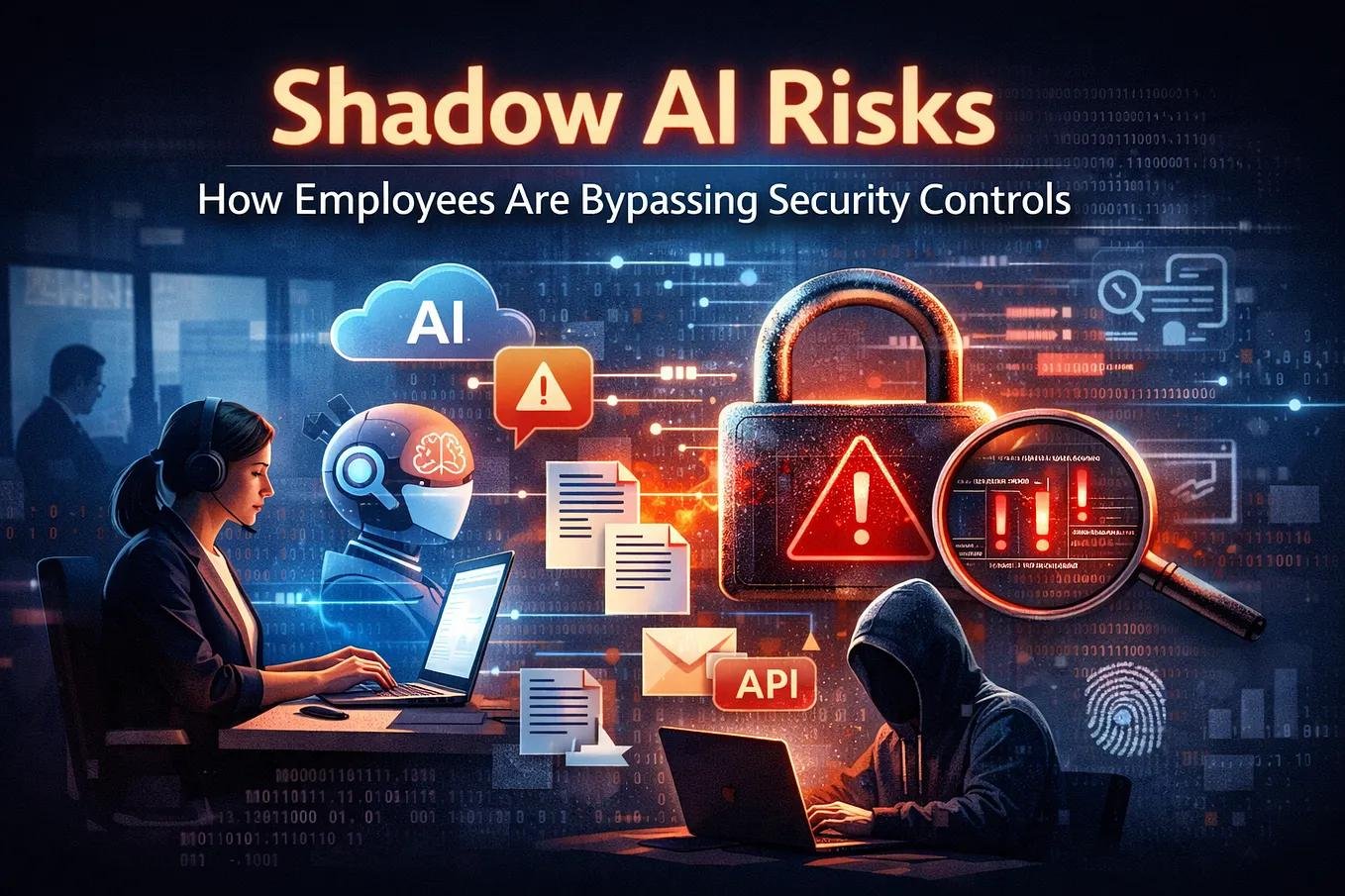
Shadow AI in 2026: Why Using AI at Work Without Approval Can Put Company Data at Risk
Artificial intelligence has quickly become part of everyday work. Employees use AI assistants to write emails, summarize documents, analyze information, create presentations, generate code, and automate repetitive tasks.
But there is a growing problem behind this productivity boom: Shadow AI.
Shadow AI refers to employees using AI applications without their organization’s IT or security teams approving, monitoring, or governing those tools. The practice is becoming an important cybersecurity issue as companies adopt more AI assistants, browser extensions, and autonomous agents.
Learn more about practical AI tools in our
10 Best AI Tools to Use Today in 2026
guide.
What Is Shadow AI?
Shadow AI is similar to the older concept of shadow IT.
With shadow IT, employees use software or technology that has not been approved by their organization. With Shadow AI, the technology is specifically an AI service or AI-powered application.
For example, an employee might use a personal AI account to:
- Rewrite a customer email
- Summarize an internal document
- Analyze a spreadsheet
- Debug company source code
- Create a presentation
- Research competitors
- Upload meeting notes
- Automate a repetitive task
The employee may simply be trying to work faster. However, the organization may have no visibility into what information was sent to the AI service.
Why Is Shadow AI Growing?
The biggest reason is simple: AI makes many everyday tasks faster.
Employees do not always want to wait for an IT department to approve a new tool when they can open an AI website and start using it immediately.
Recent research shows how quickly workplace AI adoption is expanding. Akamai’s 2026 Enterprise AI Usage Risk Report says nearly half of enterprise AI use can bypass corporate security controls, creating significant visibility gaps for security teams.
At the same time, AI is becoming more capable of performing tasks rather than simply answering questions.
Google has been developing more agentic capabilities in Gemini, including tools designed to perform multi-step tasks and work across connected applications.
That creates a new security question:
What happens when an AI tool has access to company files, applications, or accounts?
The Biggest Shadow AI Risks
1. Sensitive Data Exposure
One of the biggest risks is employees entering confidential information into an AI service.
This could include:
- Customer information
- Company documents
- Financial information
- Business strategies
- Source code
- Contracts
- Internal reports
- API keys or credentials
Once sensitive information is sent to an external service, the organization needs to understand how that provider stores, processes, and protects the information.
2. Unapproved AI Accounts
Employees may use personal accounts instead of company-managed AI accounts.
This can make it difficult for organizations to:
- Control access
- Monitor usage
- Remove access when an employee leaves
- Apply company security policies
- Investigate security incidents
3. Browser Extensions Can Create Additional Risk
AI browser extensions can be useful, but they can also introduce another layer of risk.
Security researchers have raised concerns about AI browser extensions requesting broad permissions that may allow them to interact with sensitive browser data.
Organizations should carefully evaluate browser extensions before allowing them to interact with business data.
4. AI Agents Have More Power
Traditional chatbots generally respond to prompts. AI agents can potentially perform actions.
Depending on their permissions, an agent may interact with files, applications, APIs, or other systems.
That makes unauthorized AI agents more concerning than simple chatbot usage.
5. Prompt Injection
Another emerging risk is prompt injection.
A malicious instruction can be hidden inside content that an AI system processes. If an AI agent has access to sensitive systems, a successful attack could potentially influence what the agent does.
As AI systems become more autonomous, organizations need to consider security controls that account for these new types of attacks.
How Businesses Can Reduce Shadow AI Risks
Completely blocking AI is not necessarily the best answer.
Employees are already finding useful ways to apply AI to their work. Instead, organizations should provide safe and approved alternatives.
1. Create a Clear AI Usage Policy
Employees should know:
- Which AI tools are approved
- What information can be shared
- What information must never be uploaded
- Which AI extensions are allowed
- When human review is required
The policy should be simple enough for employees to understand and practical enough to follow.
2. Provide Approved AI Tools
If employees have access to useful company-approved AI tools, they have less reason to search for random alternatives.
The goal should be:
Make the secure option the easiest option.
3. Protect Sensitive Data
Companies should use appropriate security controls to prevent confidential information from being accidentally uploaded to unauthorized AI services.
Organizations should also classify sensitive data and clearly explain which categories employees can use with AI.
4. Control Browser Extensions
Security teams should review AI browser extensions before allowing them on company devices.
Extensions should be evaluated for:
- Permissions
- Data access
- Vendor reputation
- Software updates
- Privacy policies
- Security history
5. Monitor AI Usage
Organizations need visibility into which AI services are being used.
This does not necessarily mean monitoring every employee’s conversation. Instead, security teams can focus on identifying risky applications, unusual access patterns, and unauthorized services.
6. Treat AI Agents Like Digital Employees
AI agents should receive only the permissions they actually need.
For example, an AI agent that summarizes documents probably does not need permission to send emails, modify databases, and access every company folder.
The principle should be:
Least privilege.
Give the AI only the access required for its specific task.
Should Companies Ban AI?
Probably not.
AI can provide meaningful productivity benefits when used correctly. Research continues to show productivity gains from AI in several structured work settings, although results vary significantly depending on the task and context.
Businesses can also explore practical
AI tools for everyday work
while following appropriate security and data-protection policies.
The better approach is to combine:
AI adoption + employee education + security controls + governance.
Companies that simply block every AI service may encourage employees to find alternative ways to use the technology.
The Future of Workplace AI
AI is moving beyond simple chatbots.
AI assistants are increasingly becoming capable of connecting to applications, processing information, and performing multi-step tasks.
That means companies need to think about AI security before giving AI systems broad access to business information.
The question is no longer:
“Should employees use AI?”
The better question is:
“How can employees use AI safely and productively?”
Frequently Asked Questions
What is Shadow AI?
Shadow AI is the use of AI applications by employees without formal approval or oversight from their organization.
Why is Shadow AI a security risk?
Shadow AI can expose confidential company information to AI services that have not been reviewed or approved by an organization’s security team.
Should companies ban AI tools?
Not necessarily. A better approach is to provide approved AI tools, establish clear usage policies, educate employees, and apply appropriate security controls.
How can companies reduce Shadow AI risks?
Companies can reduce Shadow AI risks by controlling access, educating employees, monitoring AI services, protecting sensitive data, reviewing browser extensions, and limiting permissions for AI agents.
Final Thoughts
Shadow AI is unlikely to disappear as AI becomes more useful.
Employees will continue looking for tools that help them write faster, analyze information, automate repetitive work, and solve problems.
The organizations that handle this well will not necessarily be the ones that ban AI.
They will be the ones that give employees useful AI tools while putting sensible security controls around them.
As AI becomes more autonomous, visibility, permissions, data protection, and employee education will become increasingly important parts of modern cybersecurity.
Frequently Asked Questions
What is Shadow AI?
Shadow AI is the use of AI applications by employees without formal
approval or oversight from their organization.
Why is Shadow AI a security risk?
Shadow AI can expose confidential company information to AI services
that have not been reviewed or approved by an organization’s security team.
Should companies ban AI tools?
Not necessarily. A better approach is to provide approved AI tools,
establish clear usage policies, educate employees, and apply appropriate
security controls.
How can companies reduce Shadow AI risks?
Companies can reduce Shadow AI risks by controlling access, educating
employees, monitoring AI services, protecting sensitive data, reviewing
browser extensions, and limiting permissions for AI agents.